How Thick Should a Concrete Slab Be?
Slab thickness is a design input based on use, loads, support, soil, joints, exposure and applicable requirements. The 2021 IRC gives a prescriptive minimum for concrete floors on ground within its scope, but that is not a universal design for every patio, driveway or garage. Once an approved thickness is known, the calculator converts it into concrete volume and bag count.
Key takeaways
- 2021 IRC R506.1 specifies at least 3.5 inches for concrete floor slabs on ground within that section's scope.
- A code minimum does not replace project-specific design for loads, soil, exposure, joints and support.
- Going from 4 to 6 inches increases concrete volume by exactly 50% for the same plan area.
- The calculator uses the thickness entered; it does not select thickness or reinforcement.
The short answer by slab type
Use type alone does not establish a thickness. Concentrated and repeated loads, subgrade support, frost, drainage, joints, reinforcement and connections can change the required section.
Take the thickness from the adopted code where a prescriptive provision applies, approved plans or the project designer. Then the concrete slab calculator converts length, width and that thickness into cubic yards and bag counts.
What building code requires for slab thickness
Section R506.1 of the 2021 International Residential Code states that concrete floor slabs on ground within its scope must be at least 3.5 inches thick. That provision has defined applicability and does not establish the complete design for every exterior slab or vehicle load.
Confirm the locally adopted edition, amendments and project documents before selecting thickness.
When to go thicker than 4 inches
Concentrated wheel or equipment loads, repeated traffic, weak or variable support, frost action, openings and edge conditions can require a different slab section.
These factors must be checked together. Increasing thickness does not correct inadequate drainage, preparation, joints or reinforcement details.
Does the slab need rebar or wire mesh
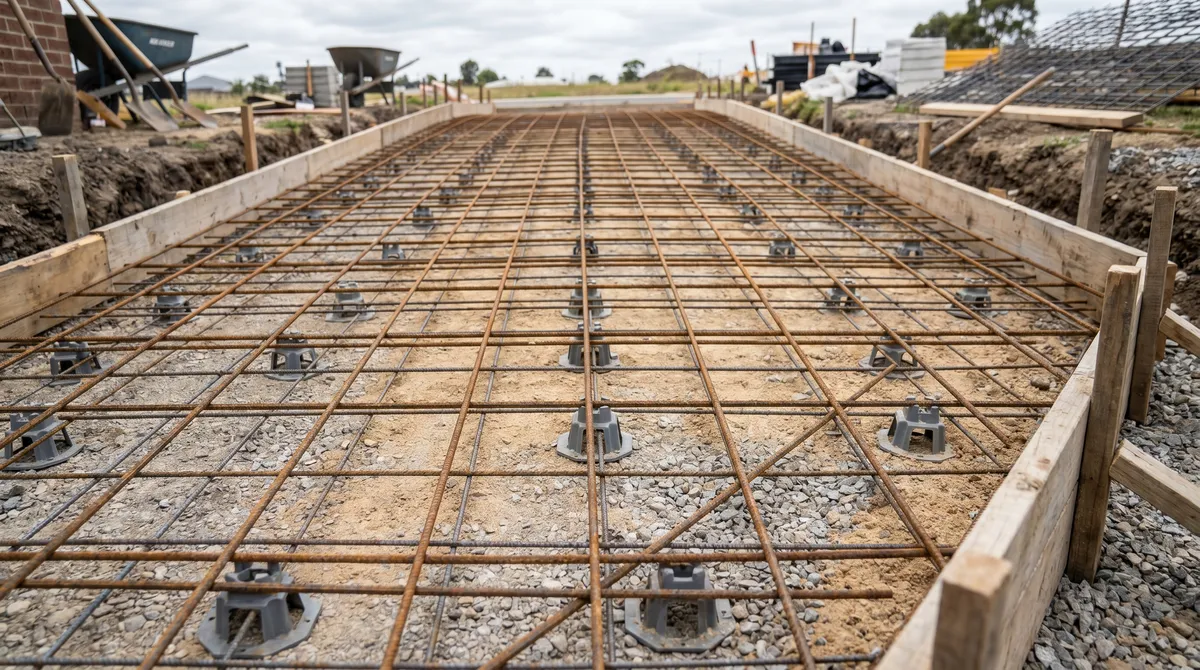
Thickness alone does not determine whether reinforcement is required or select its type, size, spacing, cover or position. Use the reinforcement schedule and joint details in the approved project documents.
The quantity calculator may count bars after those inputs are specified; it does not design the slab.
How thickness changes the concrete you order
Volume scales directly with thickness, so a thicker slab costs proportionally more concrete. For a 20 by 20 foot pad, here is the difference across common thicknesses, including a 10% waste allowance.
| 20 × 20 ft slab | Cubic yards (+10%) | 80 lb bags |
|---|---|---|
| 4 in | 5.43 | 245 |
| 5 in | 6.79 | 306 |
| 6 in | 8.15 | 367 |
The formula is simple: area in square feet times thickness in feet (the inches divided by 12), then divide by 27 for cubic yards. Anything over about a cubic yard is usually ordered as ready-mix rather than mixed by hand. Plug your numbers into the concrete calculator for exact totals.
If you are also sizing the footings that support the slab edge, use the concrete footing calculator separately.
Putting it together for your project
Record the approved thickness, base, joints and reinforcement before ordering. Enter the length, width and selected thickness in the concrete slab calculator to estimate cubic yards and bag counts.
For an L-shaped slab, split the plan into non-overlapping rectangles, calculate each volume and add the results.
Frequently asked questions
Is a 4 inch concrete slab thick enough?
What is the minimum thickness for a concrete slab?
How thick should a concrete driveway be?
Does a concrete slab need rebar?
How much concrete do I need for a 4 inch slab?
Sources and references
These references and structured source records support the method and material data used on this page.