Rebar Weight Per Foot
Rebar weight per foot runs from 0.376 lb/ft for a #3 bar up to 13.6 lb/ft for a #18 bar, set by ASTM A615. A #4 bar weighs 0.668 lb/ft and a #5 weighs 1.043 lb/ft. Here is the full chart, the formula behind it, and the metric and Canadian equivalents so you can calculate order weight.
Key takeaways
- Rebar weight per foot: #3 is 0.376 lb/ft, #4 is 0.668, #5 is 1.043, #6 is 1.502.
- The shortcut formula is weight (lb/ft) = bar number squared divided by 24.
- Grade does not change weight; a Grade 40 and Grade 60 #5 both weigh 1.043 lb/ft.
- A #4 bar equals 0.994 kg/m; the Canadian 10M is a different bar at 0.785 kg/m.
- Multiply lb/ft by total linear feet to get tonnage for ordering and freight.
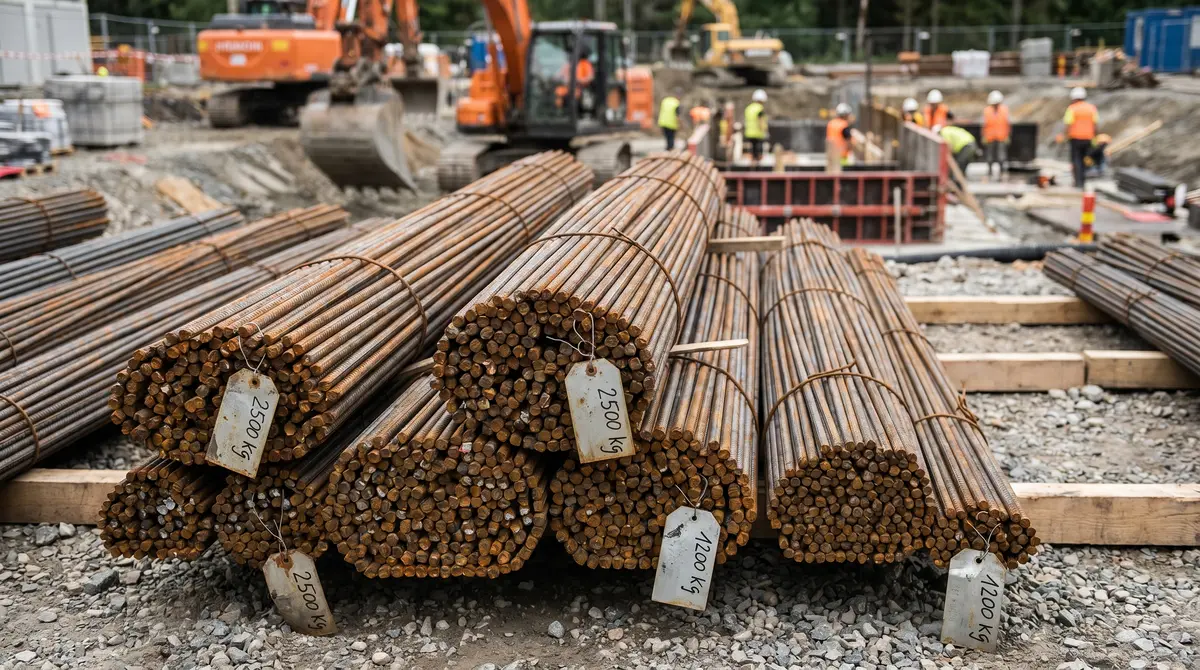
Rebar weight per foot chart (ASTM A615)
Every standard US rebar size carries a fixed weight per linear foot, defined by ASTM A615. The weight depends only on the bar diameter, so a long order is easy to price once you know the size.
| Bar size | Diameter (in) | Weight (lb/ft) | Weight (kg/m) |
|---|---|---|---|
| #3 | 0.375 | 0.376 | 0.561 |
| #4 | 0.500 | 0.668 | 0.994 |
| #5 | 0.625 | 1.043 | 1.552 |
| #6 | 0.750 | 1.502 | 2.235 |
| #7 | 0.875 | 2.044 | 3.042 |
| #8 | 1.000 | 2.670 | 3.973 |
| #9 | 1.128 | 3.400 | 5.060 |
| #10 | 1.270 | 4.303 | 6.404 |
| #11 | 1.410 | 5.313 | 7.907 |
| #14 | 1.693 | 7.650 | 11.38 |
| #18 | 2.257 | 13.600 | 20.24 |
For a full project takeoff, drop your size and total length into the rebar calculator and it returns weight, number of bars and cost in one step.
The formula behind weight per foot
The numbers are not arbitrary: they come from the cross-sectional area of the steel times its density of about 490 lb per cubic foot. For US bars there is a handy shortcut that gets you very close.
Weight (lb/ft) = Bar number² ÷ 24Weight (lb/ft) ≈ Diameter(in)² × 2.67Take a #6 bar: six squared is 36, divided by 24 gives 1.5 lb/ft, which matches the chart. This works because the bar number is the diameter in eighths of an inch, so it tracks the area neatly.
If you work from measured diameter, square the diameter in inches and multiply by about 2.67. For a half-inch #4 bar, 0.5 squared is 0.25, and 0.25 times 2.67 is 0.668 lb/ft after rounding.
Why grade does not change the weight
Rebar grade refers to the steel's minimum yield strength, not its dimensions. Grade 40, 60, 75 and 80 bars of the same size weigh exactly the same per foot.
A Grade 40 #5 and a Grade 60 #5 both come in at 1.043 lb/ft, because the diameter is identical and only the steel chemistry and rolling differ. So when you estimate tonnage, you only need the bar size, never the grade.
Calculating total weight for your order
To get total weight, multiply the weight per foot by your total linear feet of bar. Steel is sold and shipped by weight, so this is the number suppliers and freight companies care about.
Say you need 400 feet of #4 bar for a slab grid. That is 400 times 0.668, which is about 267 pounds, or just over an eighth of a ton. The rebar calculator totals this for a full grid once you enter the slab size and spacing.
If you are also pouring the slab itself, pair the steel takeoff with the concrete slab calculator so your concrete and rebar orders match the same dimensions.
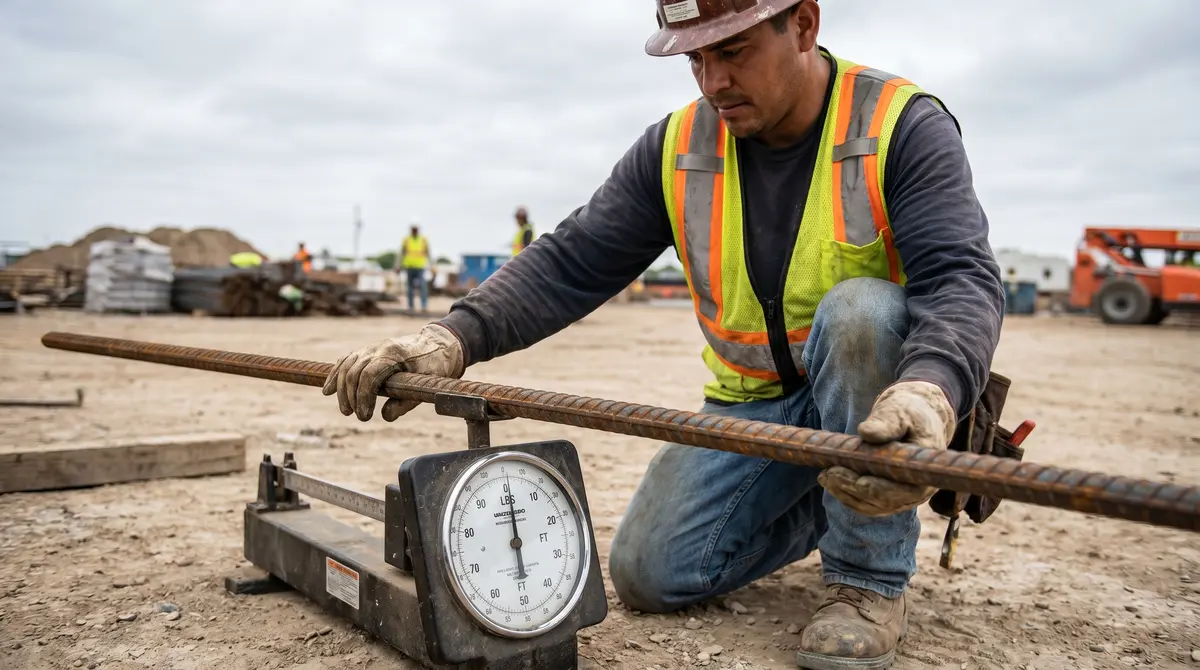
Metric and Canadian equivalents
Outside the US, rebar is labeled differently, and the designations do not line up one to one. A US #4 weighs 0.994 kg/m and is sometimes called #13 in soft metric, the same bar under a metric name at 12.7 mm diameter.
Canada uses a separate CSA G30.18 system where the number reflects cross-sectional area in square millimeters, not diameter. A 10M bar is 11.3 mm across and weighs 0.785 kg/m, so it is not the same as a #4.
| Canadian size | Diameter (mm) | Weight (kg/m) | Weight (lb/ft) |
|---|---|---|---|
| 10M | 11.3 | 0.785 | 0.528 |
| 15M | 16.0 | 1.570 | 1.055 |
| 20M | 19.5 | 2.355 | 1.583 |
| 25M | 25.2 | 3.925 | 2.640 |
| 35M | 35.7 | 7.850 | 5.275 |
When you mix metric drawings with US stock, compare actual diameter and area rather than trusting the labels, since #4, #13 and 10M are easy to confuse on a jobsite.
Picking the right size for the job
The size you choose drives both the weight and the cost. Lighter bars cover most residential work, while heavier bars belong in structural members.
The rebar size chart breaks down where each diameter is used, from #3 ties up to #11 columns. As a rough guide, #3 and #4 suit patios, footings and light slabs, #5 handles driveways and walls, and #6 and up move into commercial and structural work.
Once you have settled on a size, weight follows automatically from the chart, so estimating tonnage becomes a single multiplication against your total length.
Frequently asked questions
How much does rebar weigh per foot?
How much does a #4 rebar weigh per foot?
What is the formula for rebar weight per foot?
Does rebar grade change the weight per foot?
Is a Canadian 10M bar the same weight as a #4?
Sources and references
These references and structured source records support the method and material data used on this page.
- Rebar (Wikipedia)
- ASTM A615 standard for carbon steel reinforcing bars
- Concrete reinforcing bar sizes (Sizes.com)