How Deep Should a Footing Be?

A footing must be placed at least 12 inches below undisturbed soil and below your local frost line, whichever is deeper. That means 12 inches in frost free areas like southern Florida, but 42 to 48 inches across the Midwest and New England, and 60 inches or more in northern Minnesota and Maine. Below is what the code says, the frost depth for your region, the width and thickness that go with it, and a calculator that sizes the concrete for you.

Key takeaways

  • The bottom of a footing must be the greater of 12 inches below undisturbed soil or below the local frost line (IRC R403.1.4).
  • Frost depth ranges from 0 inches in southern Florida to 42 to 48 inches in the Midwest and New England, and 60 inches or more in the far north.
  • It is the bottom of the footing that must clear the frost line, not the top, so frost cannot get under it.
  • A spread footing must be at least 6 inches thick, with a projection of at least 2 inches on each side of the wall.
  • Rock and small detached structures under 400 sq ft are the main exceptions, but always confirm the frost depth with your local building department.
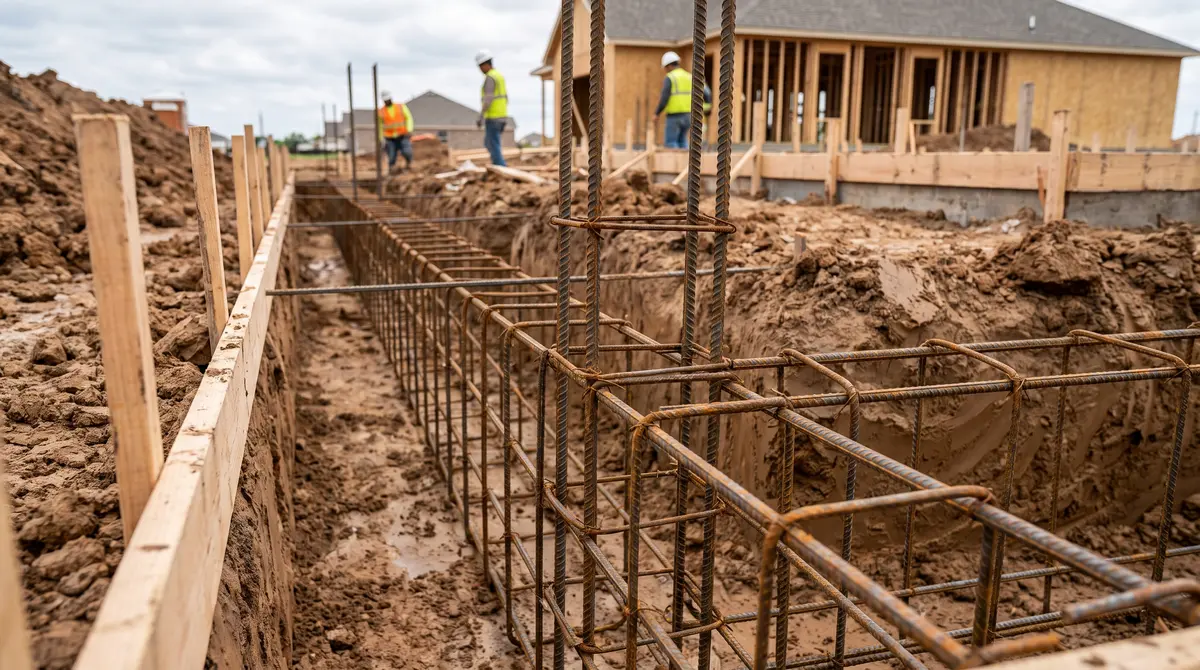
An excavated footing trench dug well below grade with rebar in place ready for a concrete pour on a house site
Concrete Footing Calculator
Skip the math: enter your measurements and get the answer.
Open the calculator →

The two rules that set minimum footing depth

Footing depth is governed by two conditions in the International Residential Code, and whichever is deeper controls. Section R403.1.4 requires that exterior footings sit at least 12 inches below undisturbed ground surface and below the frost depth set by your local jurisdiction.

The 12 inch minimum applies everywhere, even in frost free zones, because a footing needs that much cover to reach stable, load bearing soil and resist lateral movement. The frost line rule is the one that controls in cold climates, where it can push the footing far deeper.

Depth is always measured from undisturbed soil. If you have raised the grade with fill, you dig 12 inches below the original ground level, not the new surface, because loose fill and topsoil do not qualify as bearing. Once you know your depth, the concrete footing calculator turns the width, depth and length into cubic yards and bags.

How deep footings go below the frost line by region

The frost line is the maximum depth at which soil moisture is expected to freeze. Water expands about 9% when it freezes, and that swelling lifts anything sitting in frozen ground, a movement called frost heave. Set the footing below that depth and it stays in unfrozen soil year round.

The IRC does not publish a single national number. It leaves the frost depth to the local authority through Table R301.2(1), so the required depth varies dramatically by location.

RegionTypical frost depthMetric
Southern Florida, Gulf Coast0 to 12 in0 to 30 cm
Mid-Atlantic, Pacific Northwest18 to 30 in45 to 76 cm
Midwest, New England42 to 48 in107 to 122 cm
N. Minnesota, Maine, Alaska60 in or more150 cm or more

One point trips people up: it is the bottom of the footing that must clear the frost line. If your frost depth is 36 inches, the base of the footing goes below 36 inches, because frost has to get under the footing before it can heave it.

Width and thickness that go with the depth

Depth answers how far down, but a footing also has a width and a thickness. Under IRC R403.1.1, a spread footing must be at least 6 inches thick, and its width comes from Table R403.1(1) based on the stories above and the soil bearing value, defaulting to 1,500 psf.

A second rule often controls the thickness. The projection, meaning how far the footing sticks out past the wall on each side, must be at least 2 inches and cannot exceed the footing thickness. So a 16 inch footing under an 8 inch wall projects 4 inches per side and needs to be at least that thick.

Footing (W x T)Typical useInstalled cost
12 x 6 inLight one story wall4 to 5 dollars per ft
16 x 8 inStandard two story wall7 to 9 dollars per ft
24 x 12 inHeavy load or poor soil15 to 20 dollars per ft

These are prescriptive minimums for typical houses. Heavier loads, weak soil or long spans call for an engineered design.

How deep should a deck or post footing be

Deck footings follow the same frost rule: at least 12 inches below grade and below the local frost line, whichever is deeper, per IRC R507.3.3. An attached deck footing counts as exterior, so a shallow footing that heaves will rack the frame and tear the ledger off the house.

The diameter, though, comes from load, not post size. Under Table R507.3.1 you size the round footing from the tributary area the post carries and the soil bearing value, not from whether you used a 4x4 or a 6x6.

On 1,500 psf soil, a post carrying 80 sq ft of deck needs about a 24 inch diameter footing, dropping to 12 inches for a small 20 sq ft entry deck. To get the concrete volume for a round pier or a square pad at your frost depth, the footing calculator handles both shapes.

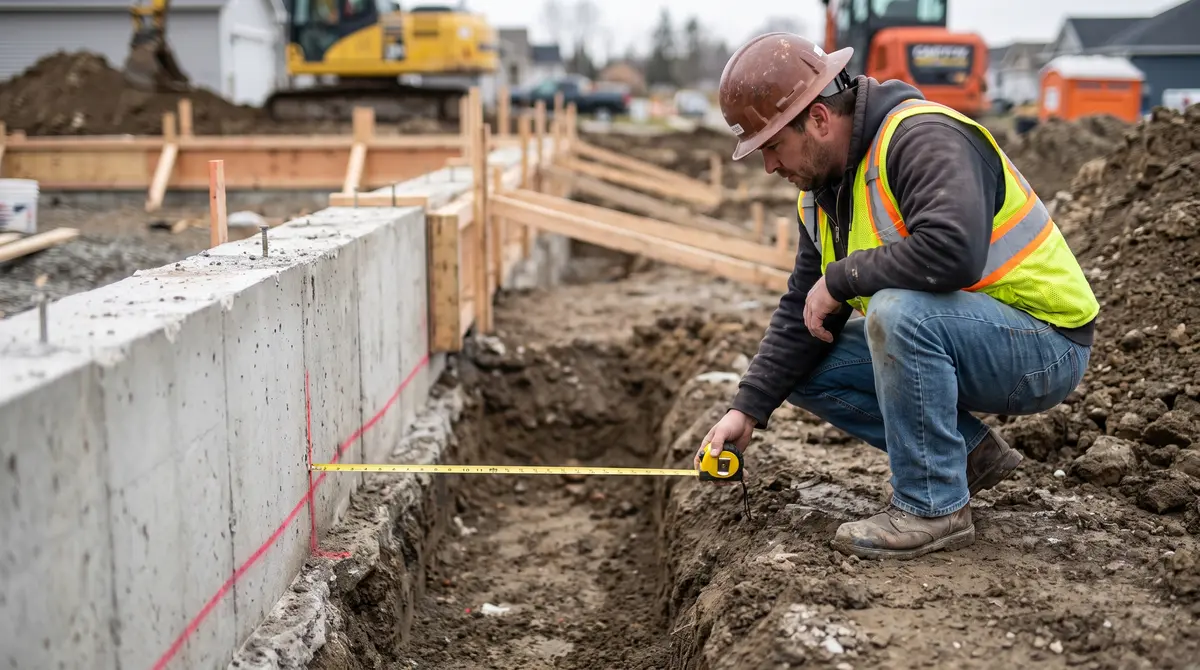
A builder checking footing trench depth with a tape measure against the frost line on a residential foundation

Exceptions: rock, small structures and shallow foundations

Three exceptions let you go shallower than the frost line. First, footings bearing on solid rock are exempt under R403.1.4.2, because rock does not heave, though the footing still needs 12 inches of depth and real bedrock, not a buried boulder.

Second, small detached structures under 400 square feet, not attached to the house and with no frost susceptible plumbing, can skip the frost depth rule. In practice many jurisdictions still require frost footings on decks and sheds, so confirm before you dig.

Third, a frost protected shallow foundation under R403.3 uses rigid foam insulation around the perimeter to keep soil under a heated building above freezing, allowing depths as shallow as 12 to 16 inches. It only works for heated structures and follows ASTM C578 for the insulation.

Cost and practical tips for digging footings to depth

Digging deeper costs more. Installed footings run about 5 to 18 dollars per linear foot in 2026, averaging 7 to 9 dollars, but a deep frost footing in the north can add 50 to 100 dollars per foot, and rocky or clay soil adds 20 to 35% for the extra excavation.

Two habits keep a footing sound. Pour onto undisturbed natural soil or properly compacted engineered fill, never onto loose backfill, topsoil or frozen ground, which is prohibited unless permanently frozen. And keep the trench bottom flat and level so the footing bears evenly.

Frost depth numbers in your local code are often more conservative than the average measured frost line, because they account for worst case winters. Always confirm the controlling depth with your building department before excavating, since local amendments can be stricter than the national map.
Cost estimate, not a quote. The prices here are ballpark figures for planning only. Real costs vary by region, supplier, season, site access and project size. Always get written quotes from local contractors before you set a budget.

Frequently asked questions

How deep should a footing be?
A footing must sit at least 12 inches below undisturbed soil and below your local frost line, whichever is deeper. That is 12 inches in frost free areas but 42 to 48 inches across much of the Midwest and New England.
How deep do footings need to be to avoid frost heave?
The bottom of the footing must go below the local frost line so frost cannot get underneath it. Frost depth ranges from 0 inches in southern Florida to 60 inches or more in northern Minnesota, Maine and Alaska, and your local building department sets the exact number.
How deep should a footing be for a deck?
A deck footing must be at least 12 inches deep and below the local frost line, the same as any exterior footing, per IRC R507.3.3. The diameter is set by the load and soil bearing, not the post size, and typically ranges from 12 to 24 inches across.
Do footings have to be below the frost line?
Yes, in most cases the bottom of an exterior footing must be below the frost line to prevent heave. The exceptions are footings on solid rock, small detached structures under 400 square feet, and engineered frost protected shallow foundations using rigid insulation.
How thick should a footing be?
A spread footing must be at least 6 inches thick under IRC R403.1.1. It also must be as thick as its projection past the wall, so a footing that sticks out 8 inches on each side needs to be at least 8 inches thick.

References

Related