How Many Concrete Blocks Do I Need?
To find how many concrete blocks you need, multiply the wall's length by its height in feet to get the area, then multiply by 1.125, since a standard 8x8x16 CMU with a 3/8 inch mortar joint covers 0.889 square feet of wall face. Below is the formula, a block count table by wall size, how many mortar bags to buy, and a calculator that handles openings and waste for you.
Key takeaways
- Blocks = wall area (sq ft) x 1.125 for standard 8x8x16 CMU, then add 5 to 10% for waste.
- A 10 ft by 8 ft wall (80 sq ft) needs about 90 blocks, or 99 with a 10% waste allowance.
- Buy about 8 to 9 bags of 80 lb pre-mixed mortar per 100 blocks, roughly 1 bag per 12 blocks.
- Subtract door and window openings from the area before multiplying, and round up to a whole block.
- The concrete-block calculator estimates face units and mortar from the entered wall and unit dimensions; footing, reinforcement, grout and labor are separate project inputs.
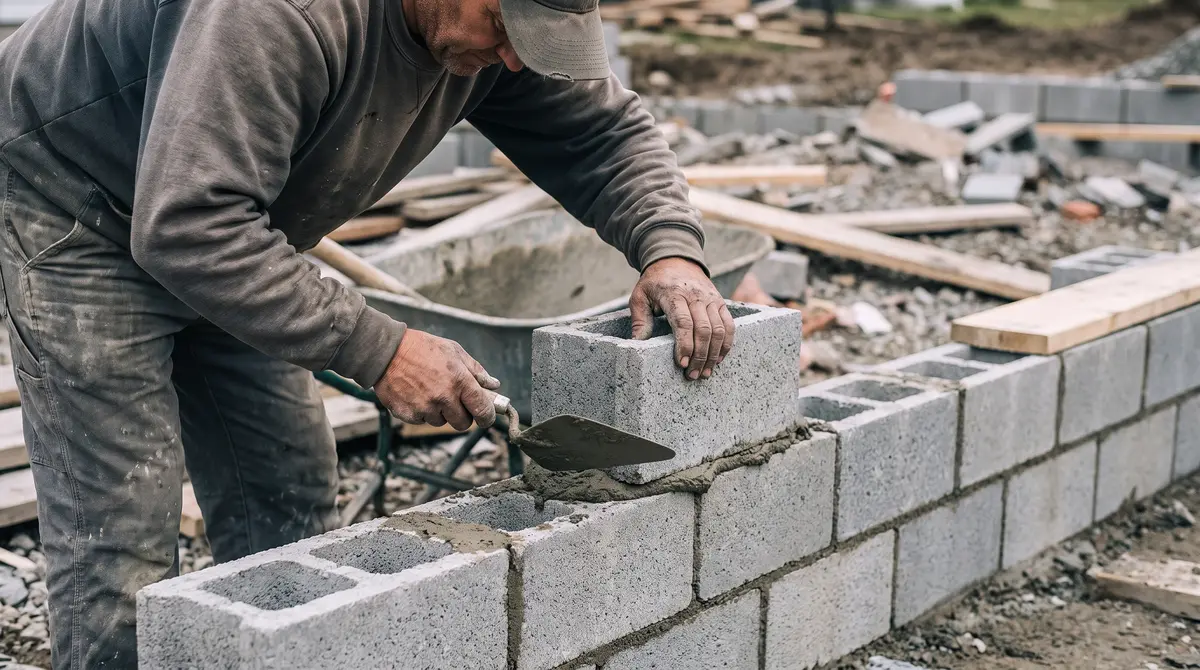
The formula: wall area times 1.125
A standard concrete masonry unit (CMU) presents an 8 inch high by 16 inch long face to the wall, and with a 3/8 inch mortar joint it occupies a modular 0.889 square feet of wall area. Flip that fraction over and one square foot of wall needs 1.125 blocks.
So the whole calculation is two steps: find the wall area, then multiply by 1.125.
Wall area (ft2) = Length(ft) x Height(ft)Blocks = Wall area x 1.125 x (1 + Waste% ÷ 100)Deduct any doors or windows from the area before multiplying, and always round the final count up. You cannot order half a block, and a wall short by even one course will stop the job.
Block count by wall size
These figures use standard 8x8x16 CMU with a 3/8 inch joint and a 10% waste allowance, which covers breakage and the cuts around corners.
| Wall (L x H) | Area (sq ft) | Blocks (+10%) | Mortar bags (80 lb) |
|---|---|---|---|
| 10 x 8 ft | 80 | 99 | 9 |
| 20 x 8 ft | 160 | 198 | 17 |
| 30 x 8 ft | 240 | 297 | 25 |
| 40 x 6 ft | 240 | 297 | 25 |
| 50 x 4 ft | 200 | 248 | 21 |
Every wall is different once openings and corners enter the picture, so treat this table as a starting budget. For your exact footprint, run the numbers through the concrete block calculator, which also returns courses and blocks per course.
How much mortar to buy
Mortar is the second line item, and it is easy to underestimate. An 80 lb bag of pre-mixed mortar mix lays roughly 12 standard blocks at a 3/8 inch joint, which works out to about 8 to 9 bags per 100 blocks.
That is different from the older rule of three bags per 100, which applies to bags of plain masonry cement mixed on site with separate sand, not to pre-mixed mortar mix bought bag for bag. Using the cement-only ratio on a pre-mixed product will leave you several bags short mid wall.
Choosing the right block width
The 1.125 blocks per square foot figure holds for any standard CMU width, because every size shares the same 8 by 16 inch face and only the depth changes. What changes is which block suits the job.
An 8 inch block is the default for loadbearing exterior walls and most foundation work. A 6 inch unit fits interior fire rated or partition walls, while 12 inch block is reserved for tall retaining walls or foundations carrying heavy loads. For the full chart of nominal versus actual dimensions across every width, see standard concrete block sizes.
If your project needs the block to also hold vertical rebar and grout, plan on ordering some open-cell or knock-out block for those courses instead of standard solid-face units.
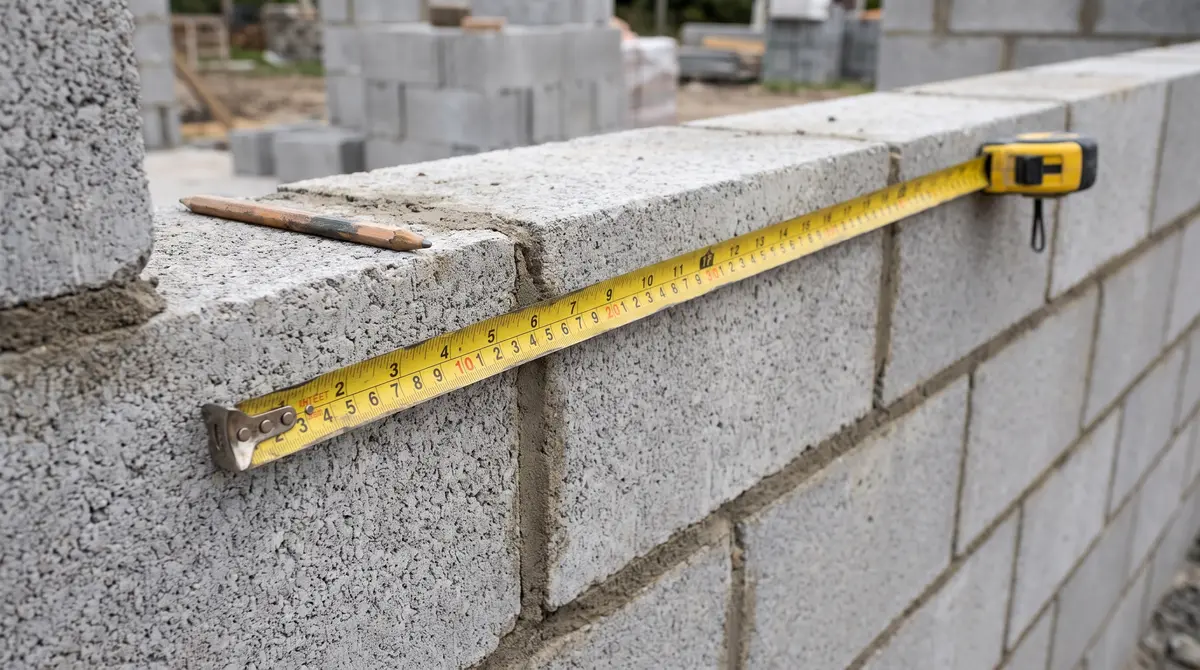
Worked example: an 8x8 foundation wall
Say you are building an 8 foot long, 8 foot high foundation wall section with standard 8x8x16 block. Area is 8 times 8, which is 64 square feet.
Multiply 64 by 1.125 for 72 blocks before waste, then add 10% to land at about 80 blocks. Mortar comes out to roughly 7 bags of 80 lb mix at one bag per 12 blocks.
Now say the wall has a 3 by 3 foot vent opening. Subtract that 9 square feet first: 55 square feet times 1.125 is about 62 blocks, plus waste. Always deduct the opening before multiplying, never after.
Reinforcement, grout, and code
Loadbearing and foundation block walls usually need vertical rebar dropped into the cells and those cells filled with grout, per the project engineering and local building code. That reinforcement does not change the block count, but it does add two more materials to your order.
Size the steel with a rebar calculator based on the spacing called out on your plans, and figure grout volume separately since it fills the hollow cores rather than the wall face. Bond beam block, with a U shaped channel on top, carries horizontal steel and is usually specified every few courses on structural walls.
Let the calculator handle openings and waste
Doing this by hand works for a single straight run, but it is easy to forget an opening or use the wrong waste factor for a wall with lots of corners. Enter your wall length, height, and any openings, and the tool returns the block count, courses, blocks per course, and mortar bags together.
For an L shaped or stepped wall, split it into straight sections, run each one through the calculator, and add the totals. That keeps the count accurate without forcing an irregular shape into one formula.
Frequently asked questions
How do you calculate the number of concrete blocks needed for a wall?
How many concrete blocks do I need for a 10x8 wall?
How many bags of mortar per 100 concrete blocks?
What is the difference between a concrete block and a cinder block?
How much does a concrete block wall cost per square foot?
Sources and references
These references and structured source records support the method and material data used on this page.
- Concrete masonry unit (Wikipedia)
- ASTM C90: Loadbearing Concrete Masonry Units
- NCMA: concrete masonry resources
- QUIKRETE Mason Mix No. 1136 product page