How Much Gravel Under a Concrete Slab?
Calculate aggregate under a slab only after the project specifies whether a base, subbase or drainage layer is required, along with its material and compacted depth. The page shows volume arithmetic at illustrative 4- and 6-inch inputs; it does not select a slab-support system or guarantee crack prevention.
Key takeaways
- Use the aggregate type and compacted depth specified for the slab, subgrade, drainage and local conditions.
- At an illustrative 4-inch depth, a 10x10 area has 1.23 cubic yards of compacted geometric volume.
- One cubic yard covers 81 square feet at 4 inches or 54 square feet at 6 inches by geometry.
- Convert compacted volume to loose volume or tons with data for the selected aggregate and supplier.
- The calculator quantifies entered dimensions; it does not design the slab base or establish a price.
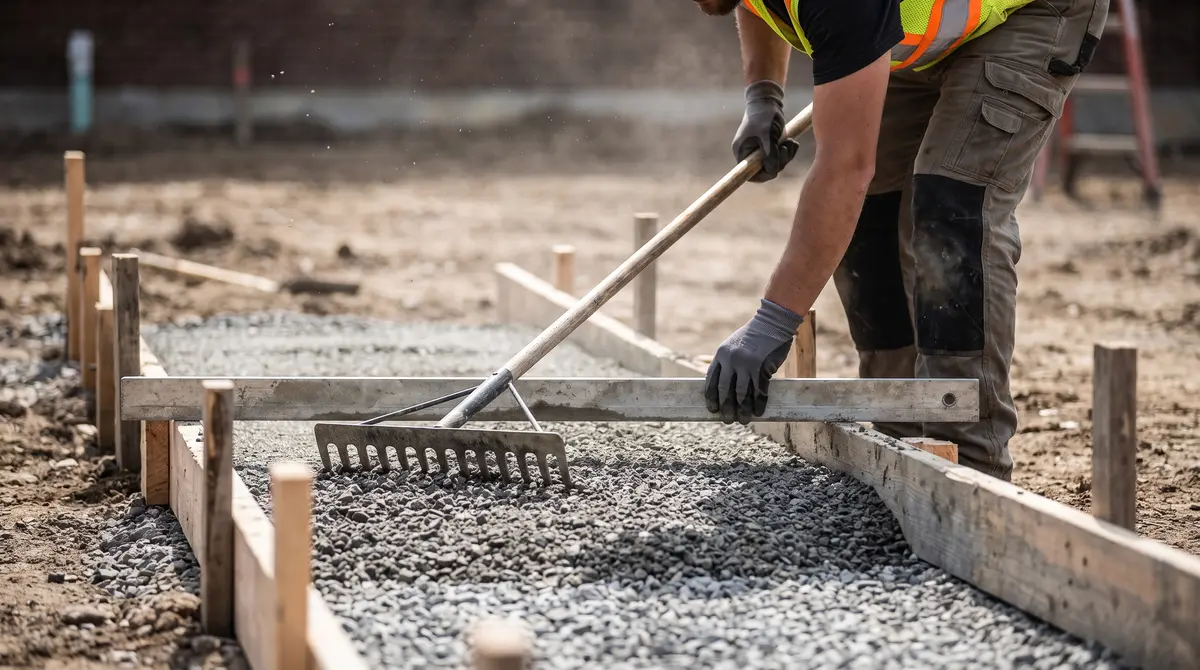
How much gravel you need under a concrete slab
Slab support and moisture-control details depend on loads, subgrade, drainage, climate, concrete design and local requirements. Some projects specify compacted aggregate; others use a different prepared support system.
| Input to obtain | What it controls |
|---|---|
| Specified aggregate | Gradation, drainage and compaction procedure |
| Compacted layer depth | Geometric volume |
| Supplier conversion | Loose order volume or tons |
| Acceptance requirement | Placement and verification |
Once these inputs are known, use the concrete slab calculator for the layer and concrete quantities.
Why a slab needs a gravel base at all
A specified aggregate layer may provide uniform support, drainage, capillary control or a working surface, depending on the complete slab system. Those functions must be coordinated with subgrade preparation, vapor control, joints and drainage.
Aggregate does not guarantee that a slab will not crack or heave. Loads, soil movement, concrete properties, thickness, reinforcement, joints, placement and curing also affect performance.
Follow the project requirements for proof-rolling or other subgrade acceptance, layer placement, moisture, lift thickness and compaction.
Gravel volume by slab size, in cubic yards and tons
Geometric volume equals length times width times compacted depth in feet, divided by 27 for cubic yards.
Cubic feet = Length(ft) x Width(ft) x (Depth(in) ÷ 12)Compacted cubic yards = Cubic feet ÷ 27Do not apply a generic tons-per-yard or compaction percentage. Convert the compacted design volume with the selected aggregate supplier's bulk density and loose-to-compacted basis.
| Area | At 4 in | At 6 in |
|---|---|---|
| 10 x 10 ft | 1.23 yd³ | 1.85 yd³ |
| 12 x 12 ft | 1.78 yd³ | 2.67 yd³ |
| 20 x 20 ft | 4.94 yd³ | 7.41 yd³ |
| 24 x 24 ft | 7.11 yd³ | 10.67 yd³ |
One cubic yard covers 81 square feet at 4 inches or 54 square feet at 6 inches by geometry. Use only the depth required by the project.
What gravel size and type to use under concrete
Use the aggregate gradation named in the project specification. Dense-graded and open-graded materials serve different functions, so visual labels such as gravel or crushed stone are insufficient for substitution.
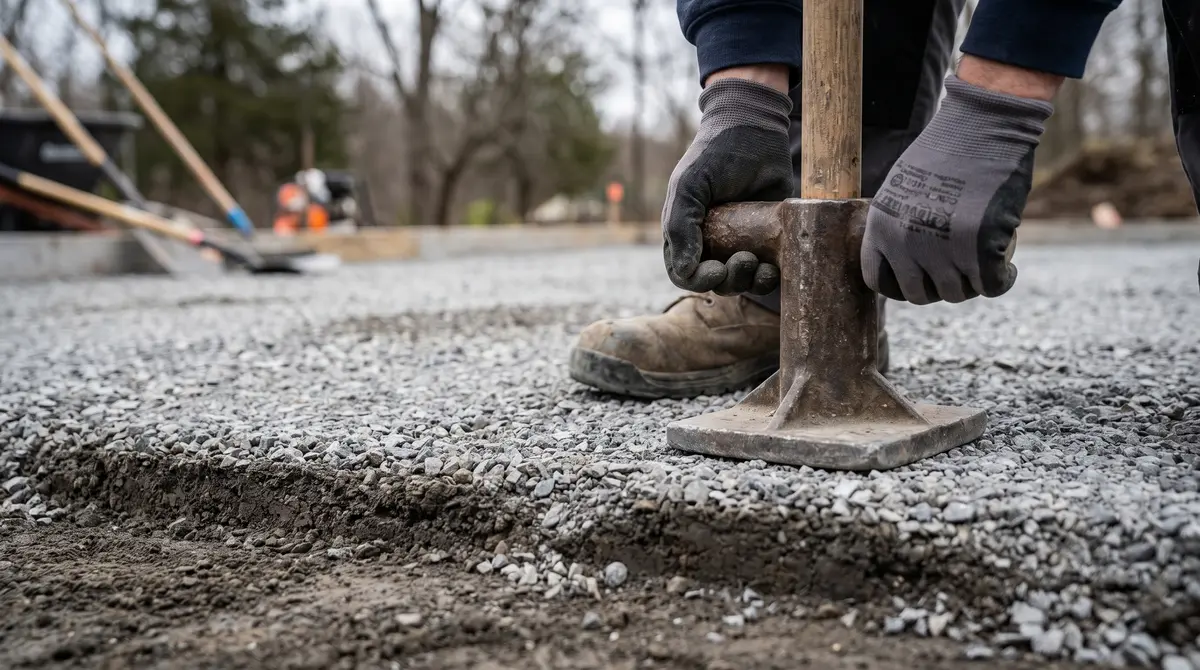
Ask the supplier for bulk density, moisture basis and loose-to-compacted conversion for the selected material. Follow the specified lift thickness, equipment and acceptance criteria rather than applying one universal compaction procedure.
What a gravel base costs installed
Request the supplier's sales unit, minimum order, delivery increment, bulk density, conversion basis and delivered price. Small-load and access terms vary and must not be inferred from a generic national rule.
Common gravel base mistakes to avoid
Common estimating errors are using an unapproved layer depth, confusing compacted and loose volume, applying a generic tons-per-yard factor and omitting delivery rounding.
State the specified aggregate, compacted geometry, supplier conversion and delivery conditions in each quote.
Do not add or omit a base solely because the slab is small. Once the required system is established, use the concrete slab calculator to quantify the layer and concrete separately.
Frequently asked questions
Is 2 inches of gravel enough under a concrete slab?
What happens if you don't use gravel under concrete?
How much will a 50 lb bag of gravel cover?
How much gravel for a 30x40 concrete pad?
Can you pour concrete directly on dirt instead of gravel?
Sources and references
These references and structured source records support the method and material data used on this page.
- American Concrete Institute (institutional site)
- Crushed stone (Wikipedia)
- NRMCA: Concrete Slab-on-Ground Construction
- QUIKRETE (manufacturer site)