How Much Paver Base Do I Need?
To estimate paver base, first use the compacted layer depth specified for the pavement system, subgrade, climate and load. Multiply the area by that depth, convert to cubic yards, then use the aggregate supplier's loose-to-compacted conversion. If the quoted loss is exactly 20%, the correct order factor is 1 divided by 0.80, or 1.25. Below are the formula and worked examples.
Key takeaways
- Use the compacted base and bedding depths specified for the chosen pavement system and site conditions.
- Compacted cubic yards = area x depth in feet divided by 27.
- Use the supplier's loose-to-compacted conversion; a stated 20% loss means dividing by 0.80, equal to multiplying by 1.25.
- Keep compacted design volume separate from loose order volume so the units are clear.
- A 10x10 ft example at 4 inches compacted is 1.23 cubic yards compacted, or 1.54 loose cubic yards if the assumed loss is exactly 20%.
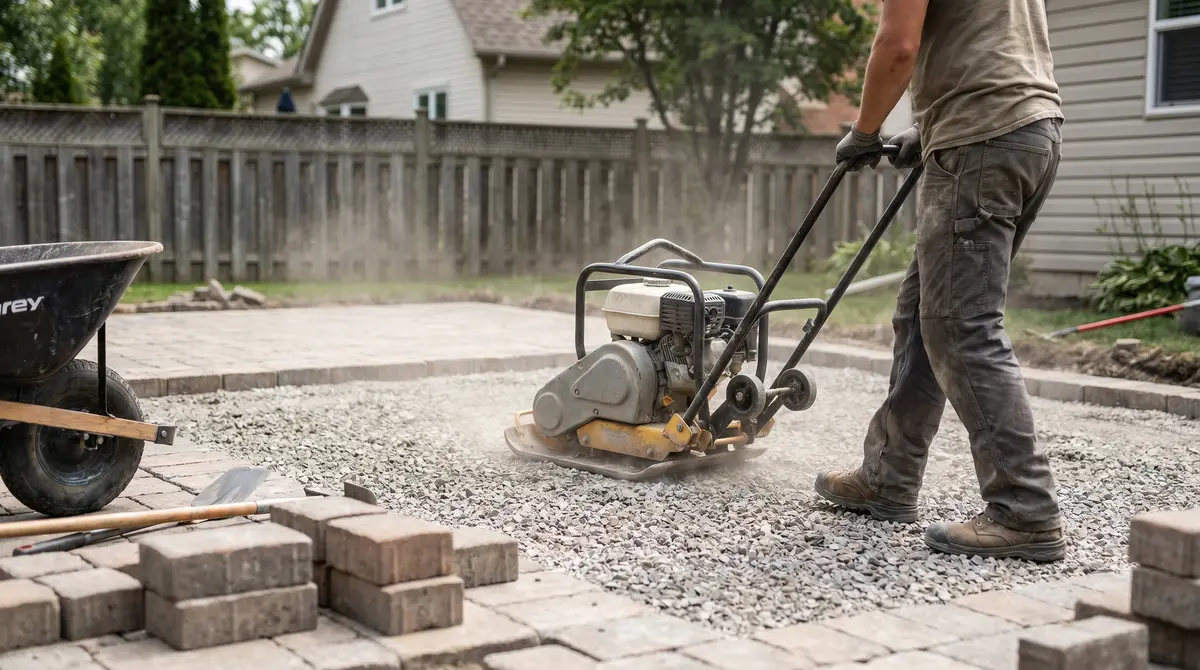
How deep should a paver base be?
Base and bedding requirements depend on the selected paver system, pedestrian or vehicle loads, subgrade, drainage, climate and local requirements. Obtain compacted layer depths and material gradations from the applicable detail before calculating quantity.
| Input to confirm | Why it matters |
|---|---|
| Application and loads | Defines the pavement system to evaluate |
| Subgrade and drainage | Affects preparation and water management |
| Base material and compacted depth | Sets geometric volume and compaction procedure |
| Bedding material and depth | Must match the selected unit system |
Do not add a generic number of inches based only on a soil label. Use the stated project detail and supplier data.
The formula for paver base material
Calculate base and bedding material as separate layers. Start with the compacted design volume: area in square feet times layer depth in feet, divided by 27.
Then convert compacted volume to the loose quantity sold by the supplier. The conversion depends on gradation, moisture, placement and equipment. If a supplier states that the material loses exactly 20% of its loose volume, 80% remains after compaction, so divide by 0.80. Multiplying by 1.20 would leave the order short.
Compacted volume (yd3) = Area(ft2) × (Depth(in) ÷ 12) ÷ 27Loose order volume = Compacted volume ÷ (1 − loss fraction)At 20% loss: Order volume = Compacted volume ÷ 0.80 = Compacted volume × 1.25Enter the design depths and the supplier's conversion in your takeoff. The paver calculator can calculate geometry, but its defaults do not replace the pavement specification.
How much paver base for a 10x10 patio
A 10 by 10 foot patio is 100 square feet. At a 4 inch compacted base, the design volume is 100 x (4 / 12) / 27 = 1.23 cubic yards. If, and only if, the supplier specifies a 20% loss from loose to compacted volume, the loose order is 1.23 / 0.80 = 1.54 cubic yards.
A 1 inch bedding layer for the same area is 100 x (1 / 12) / 27 = 0.31 cubic yards before any supplier-specific allowance. The table keeps compacted geometry and the illustrative 20% conversion separate.
| Patio size | Base, 4 in compacted | Loose base at assumed 20% loss | Bedding, 1 in |
|---|---|---|---|
| 8 × 10 ft | 0.99 yd3 | 1.23 yd3 | 0.25 yd3 |
| 10 × 10 ft | 1.23 yd3 | 1.54 yd3 | 0.31 yd3 |
| 12 × 12 ft | 1.78 yd3 | 2.22 yd3 | 0.44 yd3 |
| 16 × 20 ft | 3.95 yd3 | 4.94 yd3 | 0.99 yd3 |
Convert volume to tons with the actual bulk density supplied for the selected aggregate, then round to the supplier's delivery increment.
What gravel and sand to use
Use the base and bedding materials named in the selected paver manufacturer's or project specification. Dense-graded aggregate, open-graded aggregate and different bedding materials are not interchangeable systems.
ASTM C33 covers concrete aggregates but does not by itself select a bedding material for every paver product. Confirm gradation, moisture, compaction and layer tolerances from the applicable detail.
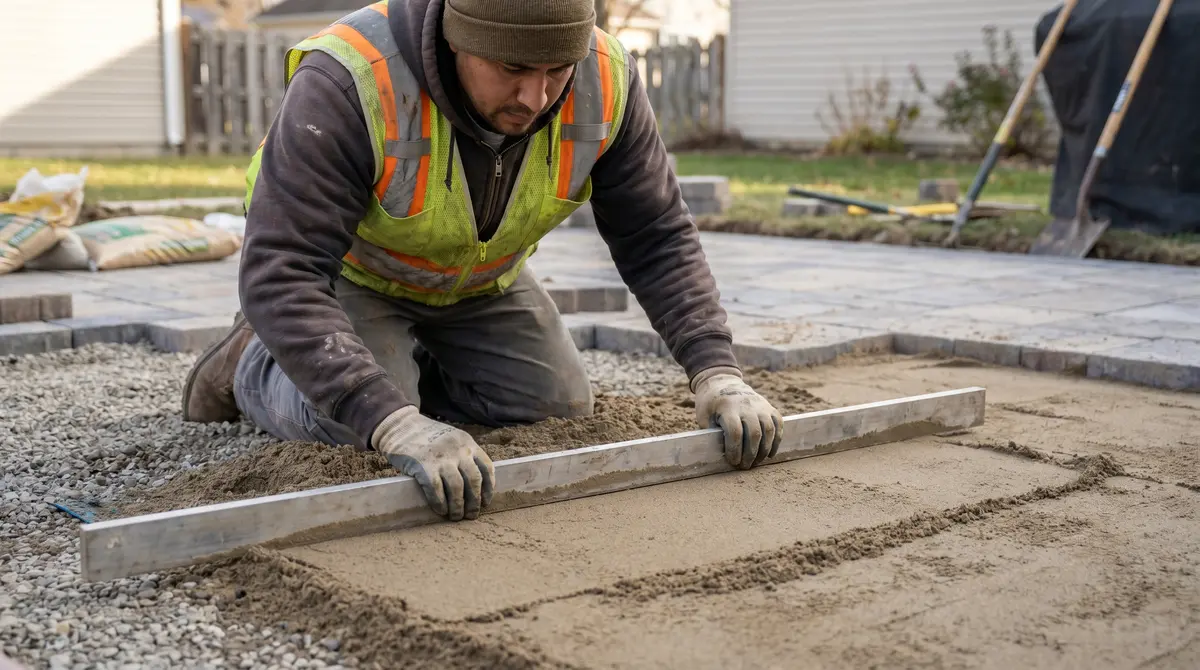
Compaction and excavation depth
Follow the specified lift thickness, moisture range, equipment and acceptance criteria for the selected aggregate and project. Excavation depth equals the combined compacted layers and unit thickness, adjusted for finished elevations and subgrade preparation.
Edge extension, surface slope and drainage details depend on the system, route and receiving drainage. Record those dimensions from the applicable detail rather than using one universal offset or slope.
If comparing a poured option, the concrete slab calculator can quantify an already specified slab section.
Convert volume into a local material order
Ask the selected supplier for the material's bulk density, loose-to-compacted conversion, sales unit, minimum delivery and delivered price. A generic cubic-yard-to-ton factor can be wrong for a different aggregate or moisture condition.
Keep base and bedding quantities separate, then round each to the supplier's delivery increment. Use the actual product and delivery quote for cost.
The paver calculator provides a geometry-based shopping list from the inputs; confirm its defaults against the selected pavement system and supplier data.
Frequently asked questions
How much paver base do I need for a 10x10 patio?
How deep should the gravel base be under pavers?
How do I allow for paver-base compaction?
How much sand goes under pavers?
Can I use 2 inches of paver base instead?
Sources and references
These references and structured source records support the method and material data used on this page.
- ICPI Tech Spec 17: Bedding Sand Selection
- ASTM C33: Standard Specification for Concrete Aggregates
- CMHA Segmental Retaining Wall Best Practices Guide (2024)
- Paver base (Wikipedia)