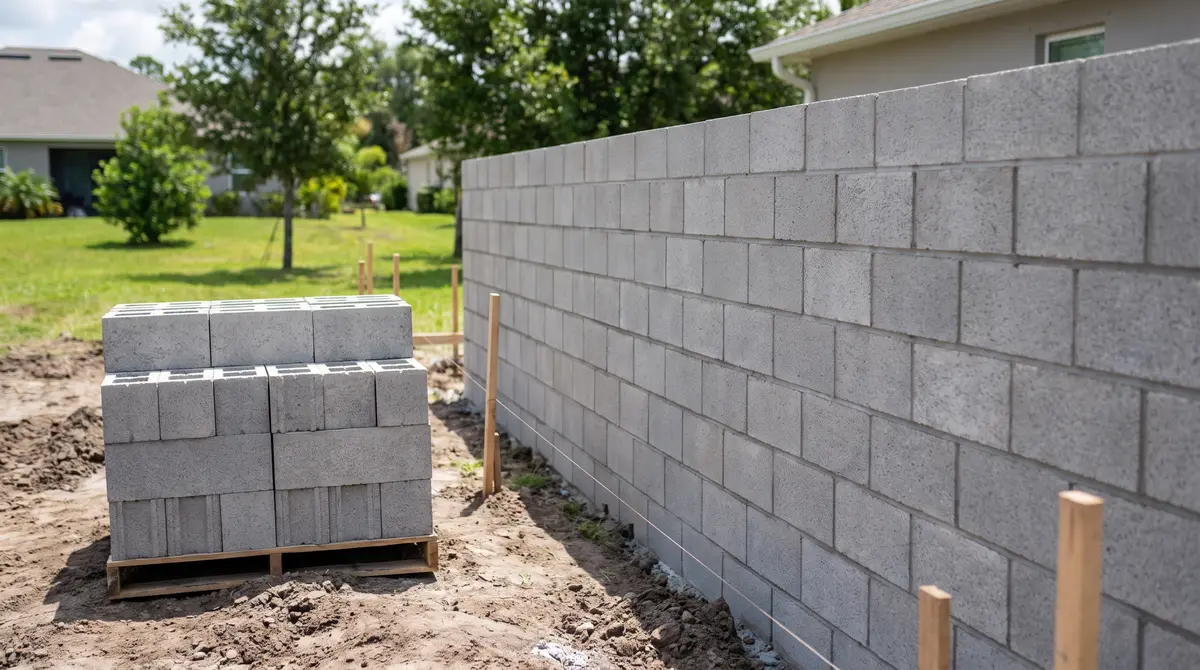
Concrete Block Wall Cost Per Square Foot
A concrete block wall costs about 15 to 32 dollars per square foot installed in 2026, with materials running 5 to 13 dollars and labor 10 to 17 dollars per square foot. Grouted, reinforced or insulated walls land at the higher end, while a simple 4 inch non-load-bearing wall costs less. Below is the full breakdown by wall type, what block and labor actually cost, and a calculator to size your own job.
Key takeaways
- Installed cost runs 15 to 32 dollars per square foot in 2026, and up to 35 dollars in high labor cost metros: standard 8 inch hollow block is 14 to 18 dollars, grouted reinforced is 18 to 24 dollars, insulated is 22 to 32 dollars.
- A single 8x8x16 block costs about 1.50 to 3 dollars, and it takes roughly 1.125 blocks per square foot, so 1,000 blocks runs about 1,500 to 3,000 dollars in material alone.
- Labor is the biggest cost driver, 45 to 65% of the total, with mason crews billing 35 to 100 dollars an hour depending on region.
- Filling cells with rebar and grout adds 2 to 8 dollars per square foot, and a stucco or plaster finish adds 6 to 9 dollars more.
- Retaining walls cost more than freestanding walls, roughly 20 to 65 dollars per square foot once footing, backfill and drainage are included.

Concrete block wall cost per square foot in 2026
Most 2026 estimates converge on 15 to 32 dollars per square foot installed for a standard residential CMU block wall, materials and labor combined, with coastal and high-labor-cost metros pushing toward 35 dollars per square foot on reinforced jobs. Simple, non-reinforced walls sit near the bottom of that range, while grouted, reinforced or insulated walls push toward the top.
Split out, materials run about 5 to 13 dollars per square foot and labor runs 10 to 17 dollars per square foot. Regional labor rates and how much reinforcement code requires explain most of the spread. To turn your own wall length and height into an exact block count and average cost, use the block wall calculator before you order anything.
Prices have moved since 2025: CMU material costs are up about 4 to 6% and mason labor is up 6 to 9% year over year, so budget on the current side of any older quote.
Cost by wall type: standard, grouted and insulated CMU
Not every block wall costs the same, because the assembly changes what goes into it. A basic 8 inch hollow wall with no fill is the cheapest; adding steel and grout, or an insulated core, raises the price per square foot.
| Wall type | Cost per sq ft (installed) |
|---|---|
| 8 in hollow, non-reinforced | $14 to $18 |
| 8 in grouted, reinforced | $18 to $24 |
| 8 in insulated / thermal-rated | $22 to $32 |
| Freestanding fence/privacy wall | $15 to $30 |
| Block retaining wall (3 to 6 ft) | $20 to $65 |
A load-bearing wall, one below grade, or one in a seismic or high-wind zone almost always needs the grouted, reinforced spec, since local building codes set minimum steel for those conditions. A simple garden wall or privacy fence under about 4 feet can often skip grout entirely.
Material costs: concrete masonry units, mortar, rebar and grout
A standard 8x8x16 CMU (concrete masonry unit) block costs roughly 1.50 to 3 dollars each at retail, with contractor-delivered pallet pricing averaging closer to 2 dollars a block. Since one square foot of wall takes about 1.125 blocks, the block itself works out to roughly 2 to 3.50 dollars per square foot before mortar, so 1,000 blocks runs about 1,500 to 3,000 dollars for material alone.
Mortar for the joints between courses adds relatively little: about 8 to 9 bags of 80 lb pre-mixed mortar per 100 blocks, a few dollars per square foot. Keep mortar joints a consistent 3/8 inch, since sloppy joints waste mortar and weaken the wall.
Rebar and core-fill grout are the bigger swing factor, adding 2 to 8 dollars per square foot once you fill cells for a structural or below-grade wall. Add a footing too, since every block wall needs one: a standard strip footing runs about 15 to 25 dollars per linear foot for concrete and labor, which spreads a few more dollars across the wall's total square footage depending on height.
Cinder block vs concrete block: does the terminology change the price?
Most people say "cinder block wall" when they mean a concrete block wall, and pricing sources use the two terms interchangeably in 2026 quotes. True cinder blocks, made with ash or coal cinders as the lightweight aggregate, are largely a mid-20th century product. Almost every block sold today uses sand, gravel or crushed stone instead, which is why it is properly a concrete masonry unit rather than a cinder block.
The distinction still matters for strength, not just cost. A true cinder block is lighter and cheaper to produce, but also weaker and more porous, so it suits a low garden wall and is a poor fit for a load-bearing or below-grade wall. If your quote specifies standard CMU rather than cinder block, that is the stronger, more common choice, and the pricing above applies either way.

Labor costs to lay concrete block
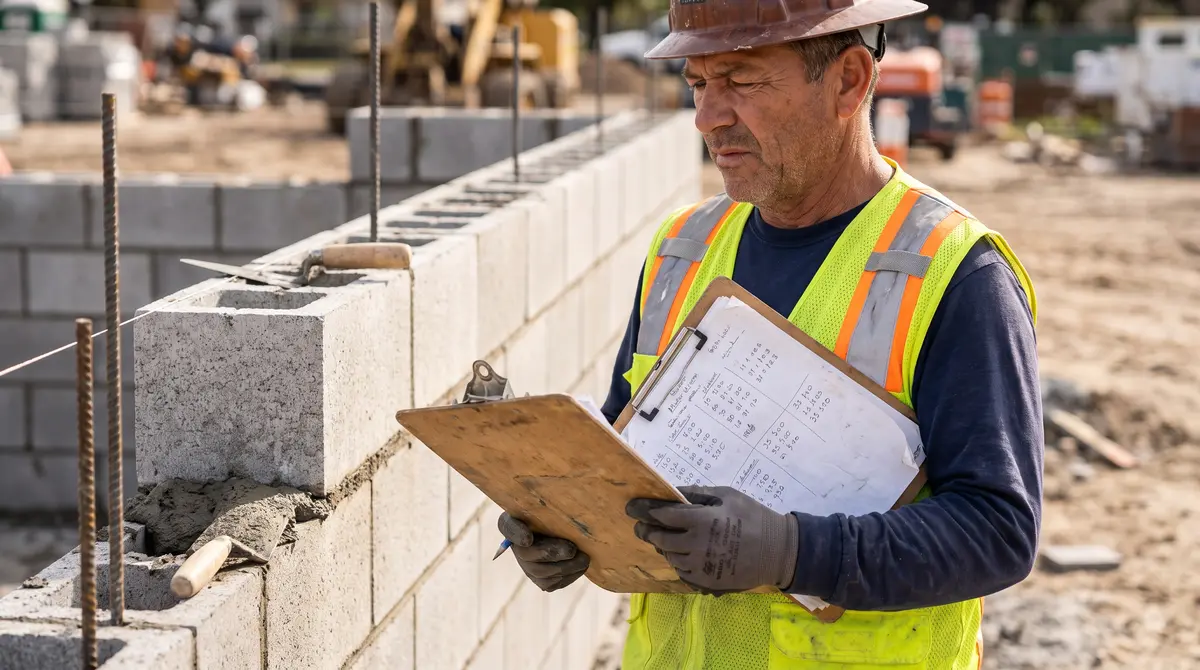
Labor is the largest share of the bill and the main cost driver, typically 45 to 65% of the installed cost. Mason crews, including a foreman, journey masons and tenders, bill anywhere from 35 to 100 dollars an hour depending on the market.
Regional labor rates explain a lot of the price gap: mason wage and burden runs around 58 dollars an hour in lower-cost Southeast and Mid-South markets, up to 96 dollars an hour in coastal California, New York and Boston. That spread alone adds 4 to 7 dollars per square foot in high-cost metros.
Taller walls add scaffolding or lift costs too, usually another 3 to 7% of the total once a crew needs equipment to reach upper courses safely.
What pushes the price higher: finish, reinforcement, permits and retaining walls
A stucco or plaster finish over block adds about 6 to 9 dollars per square foot in finishing costs, a common upgrade for a fence or privacy wall that faces the street. Paint or a masonry sealer is cheaper, usually a dollar or two per square foot.
Reinforcement is the other big add-on: filling cells with rebar and grout for a structural wall costs 2 to 8 dollars more per square foot than a plain hollow assembly, and it is required by code on load-bearing and most freestanding walls above about 4 feet.
Most homeowners also need a permit, typically 50 to 450 dollars depending on the wall's height and your local building department, plus a property survey in some areas if the wall sits on a boundary line. Skipping this upfront cost risks a stop-work order later.
Retaining walls cost the most of all, 20 to 65 dollars per square foot once you add the footing, drainage gravel, waterproofing and the extra steel a retained-earth wall needs. If you are weighing block against a poured concrete alternative and its forms, the concrete calculator sizes a poured wall the same way, in cubic yards and cost.
Example: pricing a 20x8 foot wall and an 8x12 foot wall
A 20 foot long, 8 foot tall wall is 160 square feet of wall area, a common size for a backyard privacy wall. At 14 to 18 dollars per square foot for a standard non-reinforced wall, that is roughly 2,240 to 2,880 dollars installed.
Grout the cells and add vertical rebar, as most codes require above 4 feet, and the same wall runs 18 to 24 dollars per square foot, or about 2,880 to 3,840 dollars. Add stucco and the total climbs another 960 to 1,440 dollars.
A smaller 8 by 12 foot wall is 96 square feet, which prices out to roughly 1,400 to 3,100 dollars total installed across the same 15 to 32 dollar range, depending on whether it is reinforced.
For the block count behind these numbers, about 198 blocks with a 10% waste allowance for the 20x8 wall, run your exact length and height through the block wall cost calculator.
If you are pricing out doing the labor yourself instead of hiring a mason, the full build sequence, including footing and mortar joints, is in how to build a concrete block wall.
Frequently asked questions
How much does a concrete block wall cost per square foot?
How much does a 100 square foot block wall cost?
How much does a 6 foot tall block wall cost?
How much does an 8 foot by 12 foot cinder block wall cost?
How much would 1000 cinder blocks cost?
Is a concrete block wall cheaper than a poured concrete wall?
How much of a block wall's cost is labor?
Why do retaining walls cost more per square foot than freestanding walls?
References
- Concrete masonry unit (Wikipedia)
- NCMA: concrete masonry construction resources
- ASTM C90 (standard specification for load-bearing CMU)
- QUIKRETE: mortar and mason products