How Much Concrete Do I Need?
To find how much concrete you need, multiply length by width by thickness in feet to get the volume, divide by 27 to convert cubic feet to cubic yards, then add about 10% for waste. Below is the formula in plain terms, worked examples by shape and size, the number of bags in a cubic yard, and a calculator that does the math for you.
Key takeaways
- Cubic yards = (length x width x thickness, all in feet) divided by 27, then add 5 to 10% for waste.
- A 10 x 10 ft slab at 4 inches needs about 1.23 cubic yards, or 1.36 with waste, roughly 62 bags of 80 lb mix.
- One cubic yard takes about 45 bags of 80 lb mix, 60 bags of 60 lb, or 90 bags of 40 lb.
- Order ready-mix by the yard for anything over about 1 cubic yard, since one yard is 45 bags to mix by hand.
- The optional dollar result applies an entered ready-mix price to the calculated order quantity; short-load fees, delivery, pumping, forming and placement are separate.
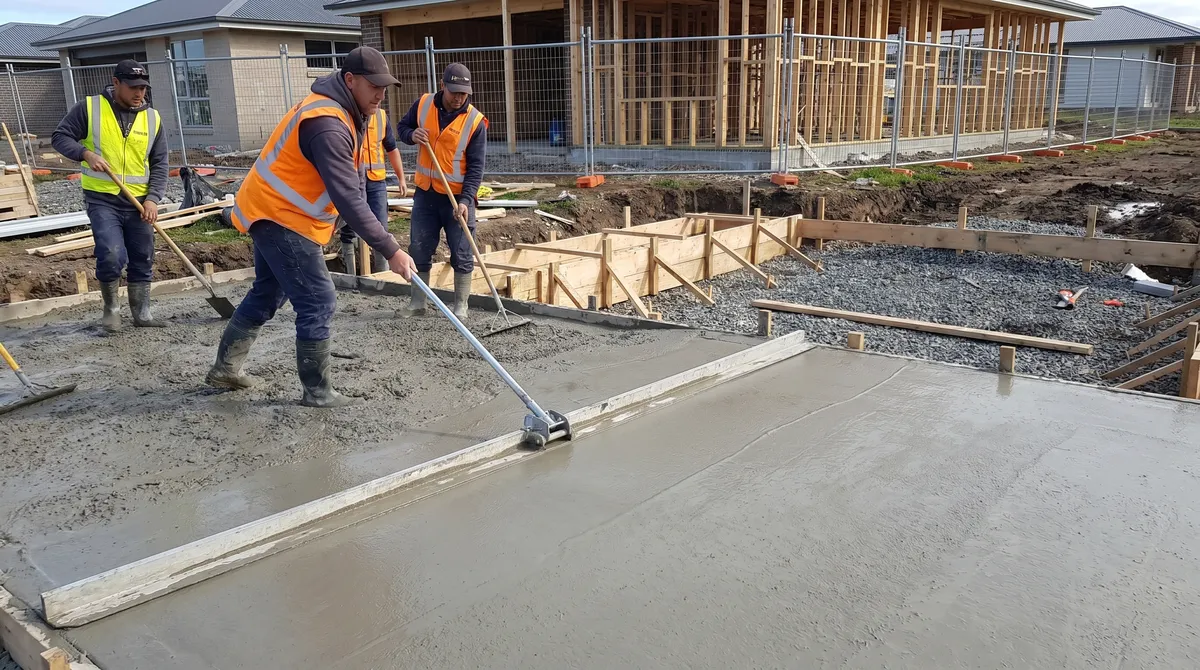
The formula to calculate concrete volume
Concrete is measured by volume, and ready-mix is ordered in cubic yards. For any rectangular pour, the volume in cubic feet is length times width times thickness, with every dimension in feet. Since thickness is usually given in inches, divide it by 12 first.
Then convert cubic feet to cubic yards by dividing by 27, because one cubic yard of concrete equals 27 cubic feet. That single division is the step most people forget.
Volume (ft3) = Length(ft) x Width(ft) x (Thickness(in) ÷ 12)Cubic yards = Volume(ft3) ÷ 27Always add a waste factor of 5 to 10%, because the subgrade is never perfectly flat and you cannot top up a pour once the truck leaves. For an exact amount of concrete with the bag counts done for you, enter the numbers in the concrete calculator.
How much concrete for a slab or patio
A slab is the most common pour, whether it is a patio, shed base or garage floor. Take the area in square feet and multiply by the thickness in feet. A 10 by 10 foot slab at 4 inches is 100 times 0.333, which is about 33.3 cubic feet, or 1.23 cubic yards before waste and 1.36 with 10%.
| Slab (4 in) | Cubic yards (+10%) | Cubic meters | 80 lb bags |
|---|---|---|---|
| 8 x 10 ft | 1.09 | 0.83 | 49 |
| 10 x 10 ft | 1.36 | 1.04 | 62 |
| 12 x 12 ft | 1.96 | 1.50 | 88 |
| 20 x 20 ft | 5.43 | 4.15 | 245 |
Thickness matters as much as the footprint. Patios and walkways are fine at 4 inches, but a driveway carrying heavier vehicles should be 5 to 6 inches, which raises the concrete volume by a quarter to a half.
Footings, fence posts and round columns
A strip footing is a long prism: length times width times depth, with the width and depth usually in inches. A 40 foot footing 16 inches wide and 8 inches deep works out to about 35.6 cubic feet, or 1.45 cubic yards with waste, ordered by the yard for a job that size.
Square footings and setting fence posts are smaller pours where bags often make more sense than a truck. For a quick estimate, the footing calculator handles the depth, width and length for you.
A round column or pier is different: its volume is pi times the radius squared times the height. A 12 inch tube 4 feet tall holds about 3.14 cubic feet, roughly 6 bags of 80 lb mix. Enter the diameter and height rather than forcing a circle into a rectangle.
How many bags of concrete in a cubic yard
One cubic yard is 27 cubic feet. The yield printed on pre-mixed concrete is about 0.60 cubic feet for an 80-pound bag, 0.45 for a 60 lb bag, and 0.30 for a 40 lb bag. So it takes roughly 45 bags of 80 lb mix to make a cubic yard, 60 bags of 60 lb, or 90 bags of 40 lb.
For the 80 lb count by common project sizes, see how many 80 lb bags of concrete in a yard.
| Bag size | Yield per bag | Bags per cubic yard |
|---|---|---|
| 80 lb | 0.60 ft3 | 45 |
| 60 lb | 0.45 ft3 | 60 |
| 40 lb | 0.30 ft3 | 90 |
That is a lot of mixing, which is why anything over about one cubic yard is usually ordered as ready-mix instead of bags. The breakdown of bags of concrete in a yard covers the cutoff where ordering by the yard beats hauling sacks.
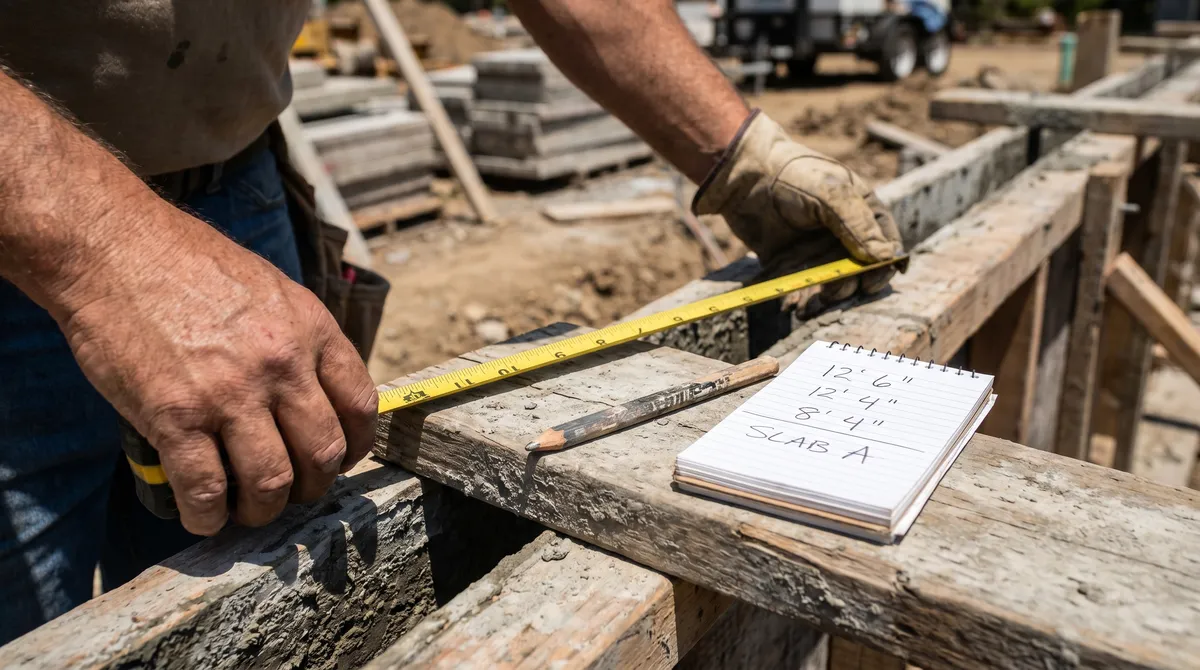
When to order ready-mix and what it costs
State the specified mix, measured volume, delivery distance, unloading method and minimum in each quote.
For an illustrative delivery worksheet only, assume 125 to 180 dollars per cubic yard and a 50 to 100 dollar short-load fee. These are not observed prices or supplier terms. Replace mix, distance, minimum order, fees and unit rate with a current local plant quote.
Tips to order the right amount and avoid running short
The most common reason people come up short is forgetting the waste, or measuring thickness wrong. A slab poured a half inch over its nominal depth across a large area is a surprising amount of extra concrete, and a soft or uneven base quietly swallows more. Add 5 to 10% and round up, every time.
The second mistake is mixing units. Keep length and width in feet and thickness in inches, then divide the thickness by 12 before you multiply. If your pour is not a simple rectangle, break it into rectangles, find each volume, and add them.
If you would rather not juggle the conversions or risk a slipped decimal, the concrete calculator returns the cubic yards, the number of 40, 60 and 80 lb bags, whether to order ready-mix, and an optional cost, for slabs, footings and round columns.
Frequently asked questions
How much concrete do I need for a 10x10 slab?
How do I calculate how much concrete I need in cubic yards?
How much will 1 yard of concrete pour?
What is the 1 2 3 rule for concrete?
How far will an 80 lb bag of concrete go?
Sources and references
These references and structured source records support the method and material data used on this page.
- Concrete (Wikipedia)
- QUIKRETE (manufacturer site)
- American Concrete Institute (institutional site)
- NRMCA: Ready Mixed Concrete