How to Calculate Concrete
Calculating concrete comes down to finding the volume of the pour and converting it to cubic yards. Measure your shape, keep your units straight, multiply for the volume, divide by 27, and add about 10% for waste. Here are the five steps with worked examples for slabs, footings and round columns.
Key takeaways
- Concrete volume in cubic feet = length (ft) x width (ft) x thickness (in) / 12.
- Divide cubic feet by 27 to get cubic yards, the unit ready-mix is sold in.
- Always add 5 to 10% for waste and round ready-mix up to the nearest quarter yard.
- A 12 x 12 ft slab at 4 inches is about 1.78 cubic yards, or roughly 88 bags of 80 lb mix.
Step 1: measure the pour
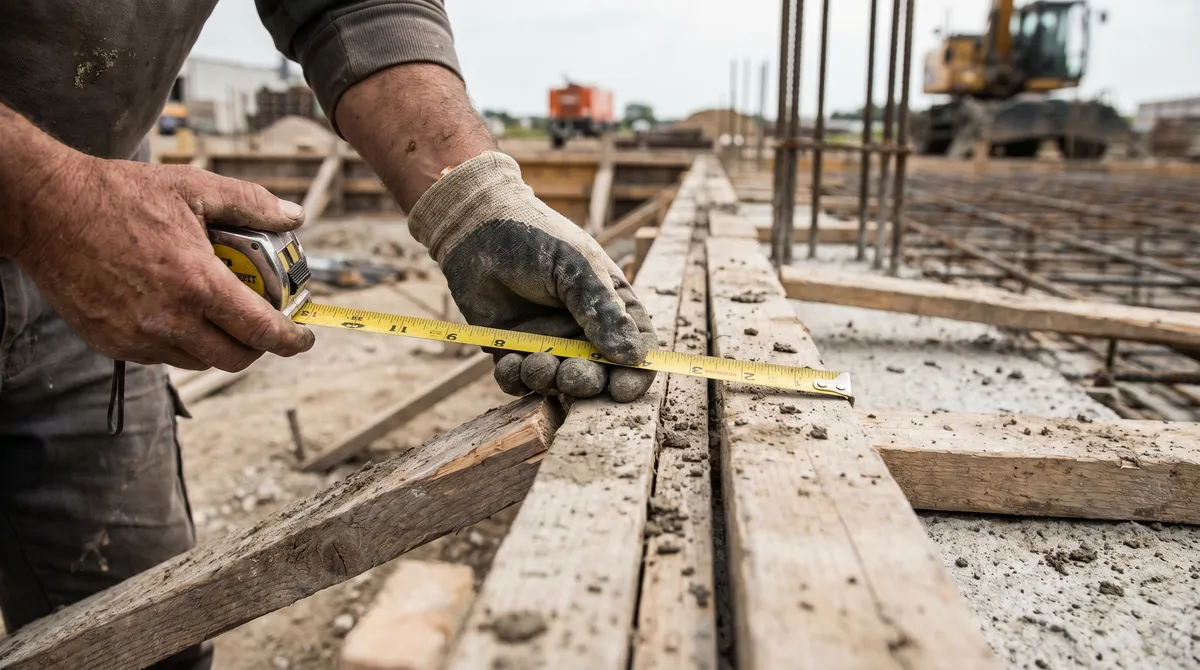
Start by measuring the shape you are pouring. For a slab or footing that means length, width and thickness. For a round column or pier it means the diameter and the height. Measure in the units you have, but be ready to convert: the volume math works best with length and width in feet and thickness in inches, the way most plans give them.
Step 2: convert the thickness to feet
Volume needs every dimension in the same unit. Since thickness is almost always given in inches, divide it by 12 to turn it into feet. A 4 inch slab is 4 divided by 12, or about 0.333 feet. A 6 inch driveway is 0.5 feet. This single step is where most by-hand errors creep in, so do it first and write it down.
Step 3: find the volume in cubic feet
Now multiply. For a rectangular pour the volume is length times width times thickness, all in feet.
Volume (ft³) = Length(ft) × Width(ft) × (Thickness(in) ÷ 12)A round column is different. Its volume is pi times the radius squared times the height, with the radius in feet. A 12 inch tube has a 0.5 foot radius, so each foot of height holds about 0.785 cubic feet. Stairs and curbs have their own shapes, which is why the dedicated tools exist, but every one of them is just a volume in cubic feet at this stage.
Step 4: convert to cubic yards
Ready-mix is sold by the cubic yard, and a cubic yard is 27 cubic feet, so divide your cubic feet by 27.
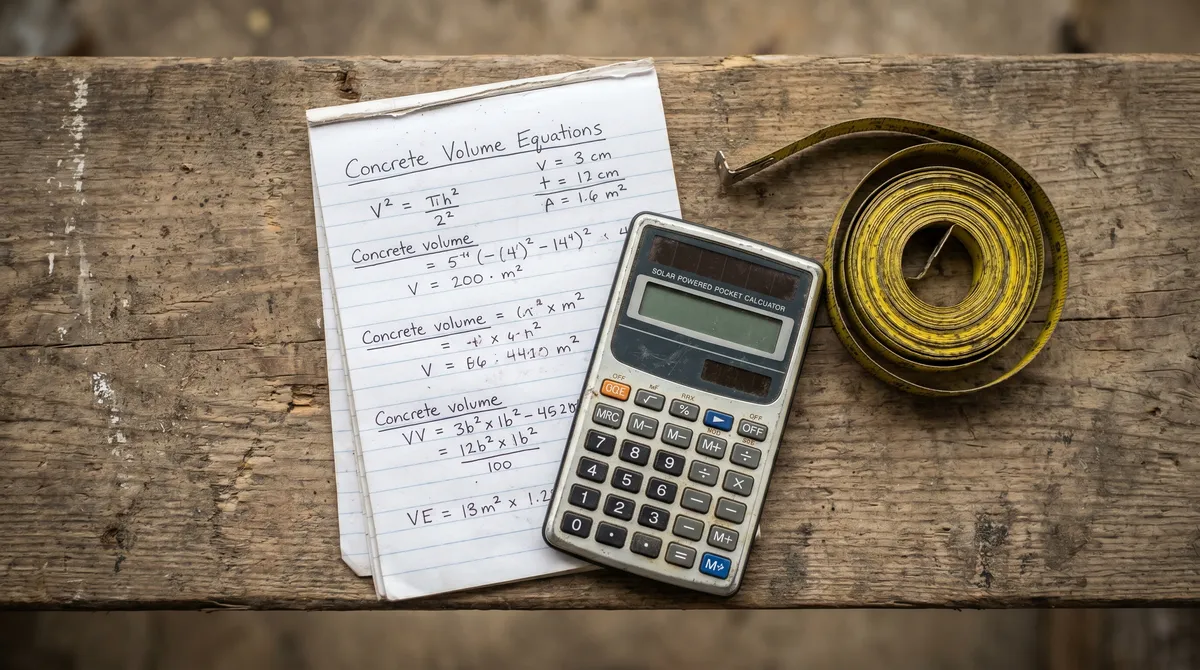
Cubic yards = Volume(ft³) ÷ 27If you are buying bags instead, divide the cubic feet by the bag yield: about 0.60 cubic feet for an 80 lb bag, 0.45 for a 60 lb, or 0.30 for a 40 lb. A 33.3 cubic foot slab is about 1.23 cubic yards, or roughly 56 bags of 80 lb mix before waste.
Step 5: add a waste allowance
Apply a project-specific allowance for subgrade variation, forms and placement. At an illustrative 10%, the 1.23 cubic yard slab above becomes about 1.36 cubic yards. Confirm order increments and delivery terms with the selected supplier.
Common mistakes that throw off the number
Three slips account for most wrong concrete orders. The first is forgetting the waste allowance and coming up short on pour day. The second is a units mix-up: treating thickness in inches as if it were feet inflates the volume twelvefold, so always convert first.
The third is forcing a round or odd shape into a rectangle. A circle is pi times the radius squared, not width times length, and an L-shape is simply two rectangles added together.
When in doubt, break the pour into simple shapes, calculate each one, and add the results, or let the calculator handle the geometry so a single decimal slip does not cost you a second delivery and a cold joint.
Worked example and the easy way
Put it together for a 12 by 12 foot patio at 4 inches: thickness is 0.333 feet, so the volume is 12 times 12 times 0.333, which is about 48 cubic feet. Divide by 27 for 1.78 cubic yards, then add 10% for about 1.96 cubic yards, or roughly 88 bags of 80 lb mix. At that size you would order ready-mix.
Doing this for one rectangle is straightforward, but odd shapes, multiple pours and the round-column formula make it easy to slip. The concrete calculator keeps the units straight and returns cubic yards, the bag count and an optional cost estimate.
For step-by-step guidance on what affects how much concrete a project needs, see how much concrete do I need.
Frequently asked questions
What is the formula to calculate concrete?
How do I calculate concrete for a slab?
How do you calculate concrete for a round column?
Why divide by 27?
Sources and references
These references and structured source records support the method and material data used on this page.