How Much Concrete for Stairs?
A basic 4 step concrete stair, 36 inches wide, needs roughly 0.65 cubic yards of concrete, about 30 bags of 80 lb mix, once you add a landing or extra width the volume climbs fast because each lower step carries the weight of every step above it. Below is the formula, worked examples by step count and width, bag counts, rebar and stringer notes, and a calculator that does the math for your exact stairs.
Key takeaways
- Volume (cubic yards) = width x tread x riser x N(N+1)/2, all in feet, divided by 27, plus 10% waste.
- Four standard steps at 36 inches wide need about 0.65 cubic yards, roughly 30 bags of 80 lb mix.
- A landing or porch pad adds volume fast: 3 steps plus a 4 foot landing can jump from 0.4 to over 1.2 cubic yards.
- Compare stair quotes with the same flight geometry, landing, formwork, reinforcement, finish, access, concrete supply and placement scope.
- The stairs calculator converts entered rise, run, width and step count into concrete volume and bag quantities; it does not design reinforcement, landings or foundations.
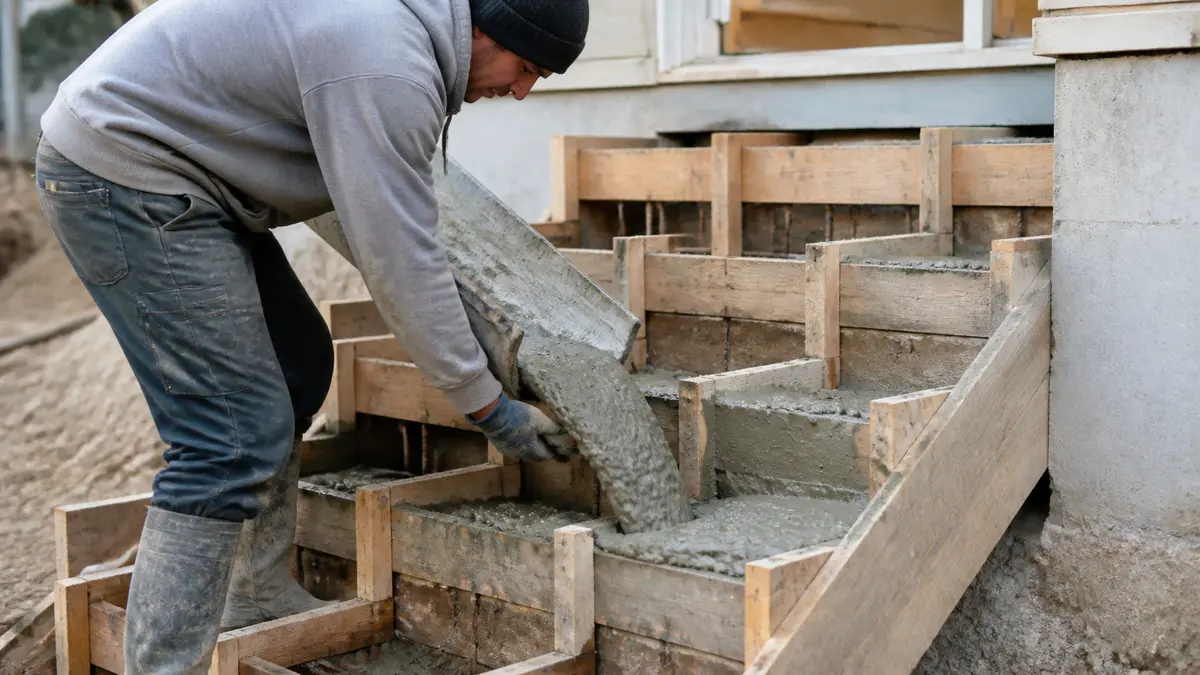
The formula to calculate concrete for stairs
Concrete stairs are poured solid, so each lower step sits under the full stack of steps above it. The volume is not just one step multiplied by the step count, because step 1 only has one riser of concrete beneath it while step 5 has five.
The formula that captures this is width x tread x riser x N(N+1)/2, with width, tread and riser all converted to feet, then divided by 27 to get cubic yards. N is the number of steps, and N(N+1)/2 is the sum of 1 through N, which accounts for the growing depth under each step.
Cubic feet = Width(ft) x Tread(ft) x Riser(ft) x [N x (N+1) ÷ 2]Cubic yards = Cubic feet ÷ 27Always add 5 to 10% for waste, since the subgrade under a stair pour is rarely perfectly even. For the exact number with your own step count, width, rise and run already worked out, use the concrete stairs calculator.
Concrete needed by number of steps (worked examples)
Using illustrative 7 inch riser and 11 inch tread dimensions after compliance is confirmed, here is how volume scales with step count and stair width. Figures include a 10% waste allowance.
| Steps | 36 in wide (cu yd) | 36 in wide (bags) | 48 in wide (cu yd) | 48 in wide (bags) |
|---|---|---|---|---|
| 3 | 0.39 | 18 | 0.52 | 24 |
| 4 | 0.65 | 30 | 0.87 | 39 |
| 5 | 0.98 | 44 | 1.31 | 59 |
| 6 | 1.37 | 62 | 1.83 | 82 |
Notice how a 6 step run needs more than triple the concrete of a 3 step run, not double, because of the cumulative N(N+1)/2 term. Wider stairs scale in direct proportion to width, so a 60 inch stair is 25% more concrete than a 48 inch stair with the same step count.
Adding a landing or porch pad
Most entry stairs end at a landing or porch slab, and that flat section often uses more concrete than the steps themselves. A landing is calculated as a simple slab: depth x width x thickness, exactly like the concrete slab calculator handles for patios and pads.
As a real-world reference, 3 steps with no landing run about 0.38 cubic yards (18 bags), but adding a 4 foot deep landing at the same width pushes the total to roughly 1.22 cubic yards, about 55 bags. Measure the landing separately, then add its volume to the stair volume before ordering.
How many bags of concrete for steps
An 80 lb bag of pre-mixed concrete yields about 0.60 cubic feet once mixed, so it takes roughly 45 bags to make one cubic yard, 60 bags at 60 lb, or 90 bags at 40 lb. Most residential stair pours land between 0.4 and 1.5 cubic yards, which keeps them in bag territory rather than a full truck.
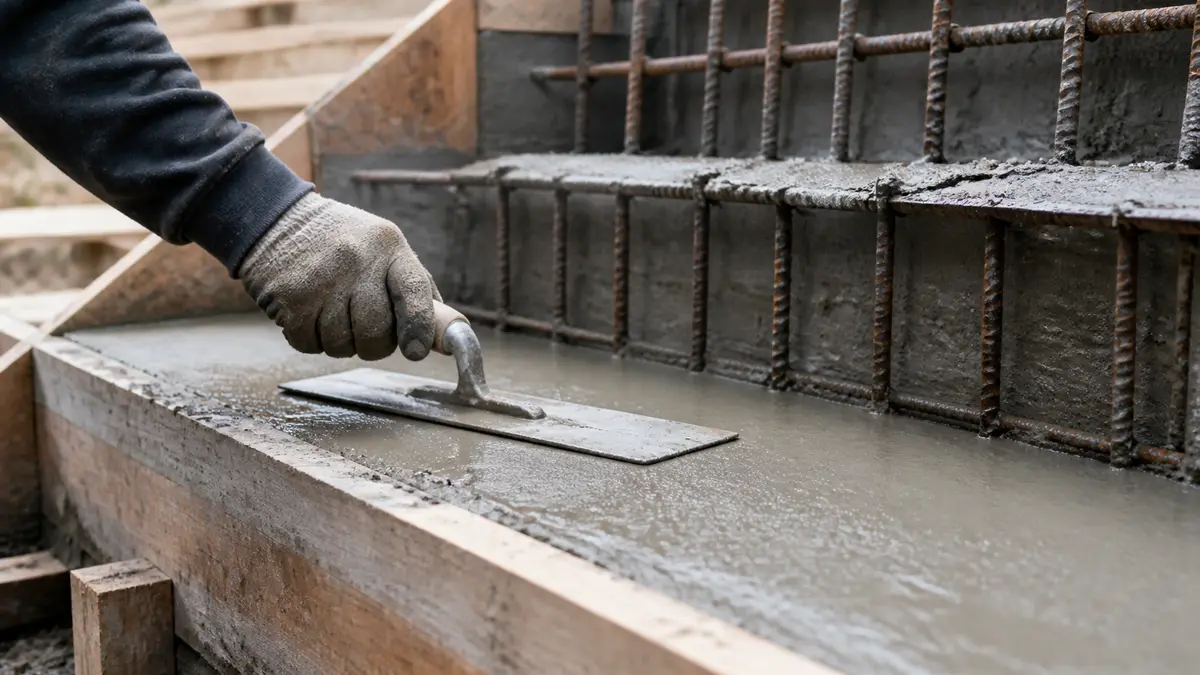
Stringer length and rebar for concrete stairs
A precast or form-built stair needs geometry coordinated with the approved rise, run, landing and support details. The example dimensions are illustrative and do not select lumber or formwork.
Use the reinforcement, cover, anchorage and footing details shown in the approved design. The volume calculator does not design stair reinforcement.
Ready-mix cost and ordering tips for stair pours
QUIKRETE Concrete Mix or QUIKRETE 5000 are both rated for building new steps, mixed on site and placed in lifts if the pour is deep. Wet the subgrade, brace the forms well since stair forms take more hydraulic pressure than a flat slab, and finish each tread with a slight forward slope so water sheds off rather than pooling.
Frequently asked questions
How long is 2x12 for a 5 step stringer?
Can you use Quikrete for stairs?
How much to pour 3 concrete steps?
How far will an 80 lb bag of concrete go?
Do concrete stairs need rebar?
Sources and references
These references and structured source records support the method and material data used on this page.
- QUIKRETE: Concrete Steps and Ramps (project guide)
- American Concrete Institute (institutional site)
- NRMCA: Ready Mixed Concrete
- Stairs (Wikipedia)