How Much Rebar Do I Need?
To find how much rebar you need, divide each slab dimension by your bar spacing, add one, and that is the bar count in each direction. Most residential slabs use a #4 grid at 12 to 18 inch spacing. Total the linear feet both ways, add about 10% for lap splices and waste, then order standard 20 foot sticks. Here is the formula, a worked example, and a calculator that does the counting.
Key takeaways
- Bars one way = (slab length in feet divided by spacing in feet) + 1, then repeat for the other direction.
- A 12 ft x 12 ft slab with a #4 grid at 16 inch spacing needs about 20 bars, roughly 240 linear feet.
- Standard spacing is 12 inches for driveways, 16 to 18 inches for patios and residential slabs.
- Add 10% for lap splices (overlap full sticks by about 40 bar diameters) and cutting waste.
- Rebar comes in 20, 40 and 60 ft sticks; #4 weighs 0.668 lb per foot, #5 weighs 1.043 lb per foot.
The rebar quantity formula for a slab
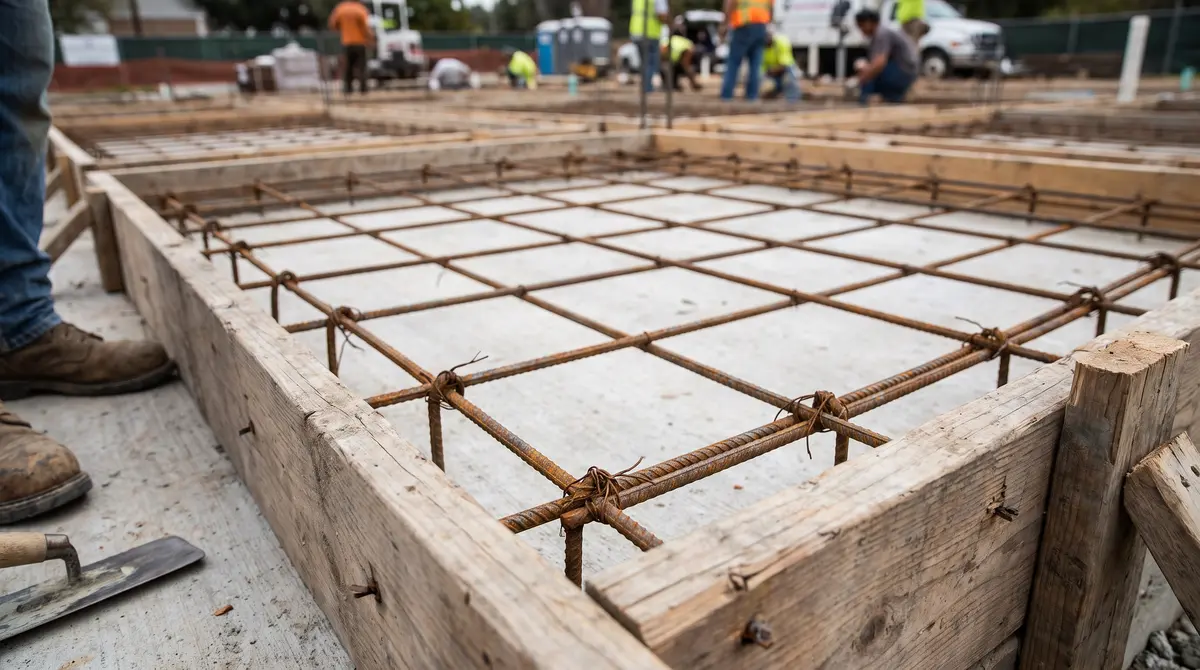
Rebar in a slab is laid as a grid, so you count the bars running each way and add them up. The number of bars in one direction is the slab length divided by the spacing, plus one for the bar at the far end.
Bars one way = (Slab length(ft) ÷ Spacing(ft)) + 1Total length = (Bars one way × slab width) + (Bars other way × slab length)Spacing is measured center to center, and it is usually given in inches, so convert it to feet first. A 16 inch spacing is 1.33 feet. Once you have the total linear footage, add about 10% for lap splices and waste, then divide by your stick length to get the number of pieces to buy.
If you would rather skip the arithmetic, enter your slab size and spacing in the rebar calculator and it returns the bar count, total length and weight for you.
A worked example: a 12x12 slab
Take a 12 by 12 foot patio with a #4 grid at 16 inch spacing. Bars one way are 12 divided by 1.33, which is 9, plus 1, so 10 bars. The slab is square, so it is 10 bars the other way too, 20 bars total.
Each bar spans 12 feet, so the raw length is 20 times 12, which is 240 linear feet. Add 10% for laps and waste and you are near 264 feet, or about fourteen 20 foot sticks of #4 rebar.
| Slab | Spacing | Bars (total) | Linear ft (+10%) |
|---|---|---|---|
| 10 × 10 ft | 18 in | 16 | 176 |
| 12 × 12 ft | 16 in | 20 | 264 |
| 20 × 20 ft | 12 in | 42 | 924 |
| 24 × 24 ft | 12 in | 50 | 1320 |
What spacing and bar size to use
Spacing and bar size depend on the load. For most residential slabs, an 18 inch grid in both directions with #4 (half inch) bar is the common starting point. Patios and walkways often use the same.
Driveways and garage floors that carry vehicles usually tighten to 12 to 16 inch spacing, and may step up to #5 (five eighths inch) bar. Closer spacing and bigger bars mean more steel and more load capacity, but also more cost.
If you are still deciding which bar to use, the rebar size chart lays out the diameters, areas and weights side by side.
Don't forget lap splices and waste
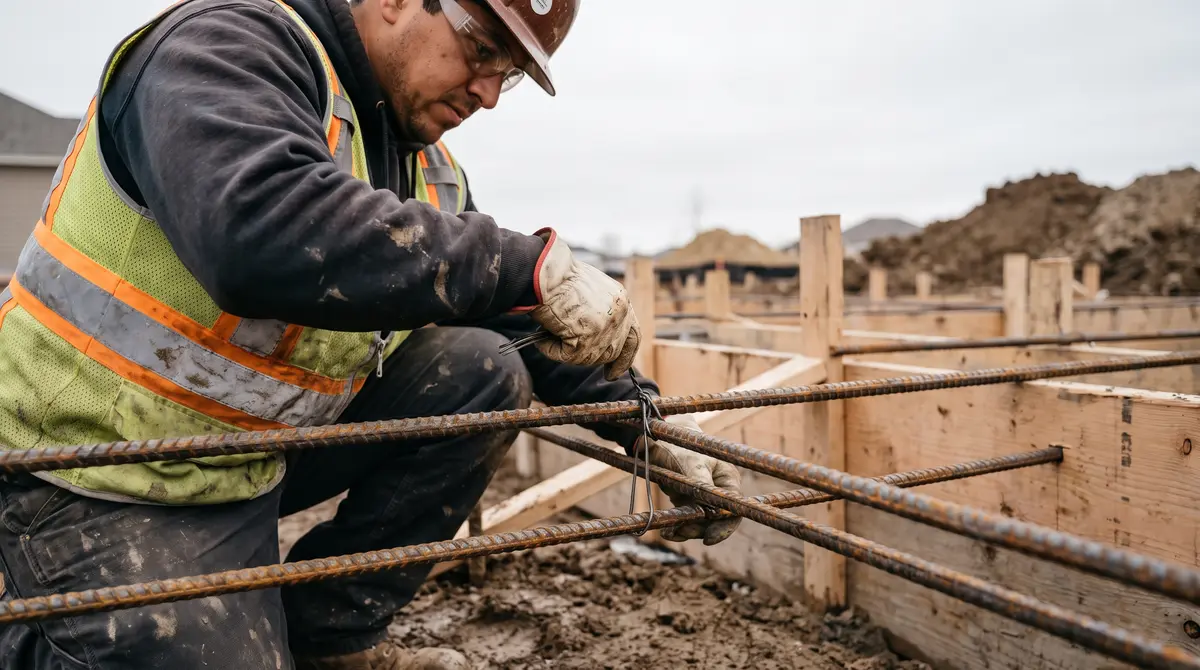
Rebar comes in standard stock lengths, most often 20 feet, but also 40 and 60. When a run is longer than a single stick, you cannot butt the ends together: the bars must overlap so the load transfers through the concrete.
A common field rule is to lap by about 40 bar diameters. For a #4 bar that is roughly 20 inches; for a #5 it is about 25 inches. The exact lap depends on concrete strength and the splice class under ACI 318, so check your drawings for anything structural.
Those overlaps eat into your linear footage, which is why you add a margin on top of the raw count. Adding 10% covers laps, corner cutoffs and the odd damaged bar, and keeps you from coming up one stick short on pour day.
Turning length into weight and cost
Suppliers often price and ship rebar by weight, so it helps to convert your linear footage. Per ASTM A615, #4 rebar weighs 0.668 pounds per foot and #5 weighs 1.043 pounds per foot, regardless of grade.
| Size | Diameter | Weight (lb/ft) | Metric (Canada) |
|---|---|---|---|
| #3 | 3/8 in | 0.376 | 10M (near) |
| #4 | 1/2 in | 0.668 | 10M / 15M |
| #5 | 5/8 in | 1.043 | 15M |
| #6 | 3/4 in | 1.502 | 20M (near) |
Canada and most of Europe use soft metric designations. A US #5 matches a Canadian 15M almost exactly by area (200 mm squared), while a #4 sits between 10M and 15M, so confirm actual dimensions before substituting.
Let the calculator count it
Counting bars by hand is fine for one square slab, but it is easy to drop the plus one or fumble the inch to foot conversion. Enter your slab length, width, spacing and bar size in the rebar calculator and it returns the bar count each way, the total linear feet, the weight, and how many 20 foot sticks to order.
If you are still working out the slab itself, the concrete slab calculator sizes the pour first, then you can lay the rebar grid over those dimensions. For irregular shapes, break the slab into rectangles, run each one, and add the bars together.
Frequently asked questions
How much rebar do I need for a 12x12 slab?
How do I calculate how many rebar pieces to buy?
What spacing should rebar be in a slab?
How much extra rebar should I order?
How much does rebar weigh per foot?
Sources and references
These references and structured source records support the method and material data used on this page.
- ASTM A615: Standard Specification for Deformed Steel Bars
- American Concrete Institute (institutional site)
- CRSI: Splicing reinforcing bars
- Rebar (Wikipedia)