How to Lay Pavers
To lay pavers, excavate 7 to 10 inches deep, compact a 4 to 6 inch crushed gravel base for a patio (8 to 12 inches for a driveway), screed a 1 inch sand bedding, set the pavers with edge restraints, then compact and sweep polymeric sand into the joints. This guide walks each step with real depths, a slope for drainage, and how much base, sand and pavers to order.
Key takeaways
- Dig 7 to 10 inches deep for a patio: paver thickness plus 1 inch sand plus a 4 to 6 inch gravel base; go deeper for driveways.
- Use 3/4 inch minus crushed gravel for the base and coarse concrete sand (not stone dust) for the 1 inch bedding layer.
- Compact the gravel in 2 to 4 inch lifts and slope the whole build 1/4 inch per foot (about 2%) away from the house.
- The paver calculator quantifies units, base and sand from the dimensions and depths entered; it does not select excavation depth, drainage or compaction requirements.
- One 50 lb bag of polymeric sand fills roughly 75 to 100 sq ft of tight joints, near 1 bag per 100 sq ft in practice.
Plan the layout and set a drainage slope
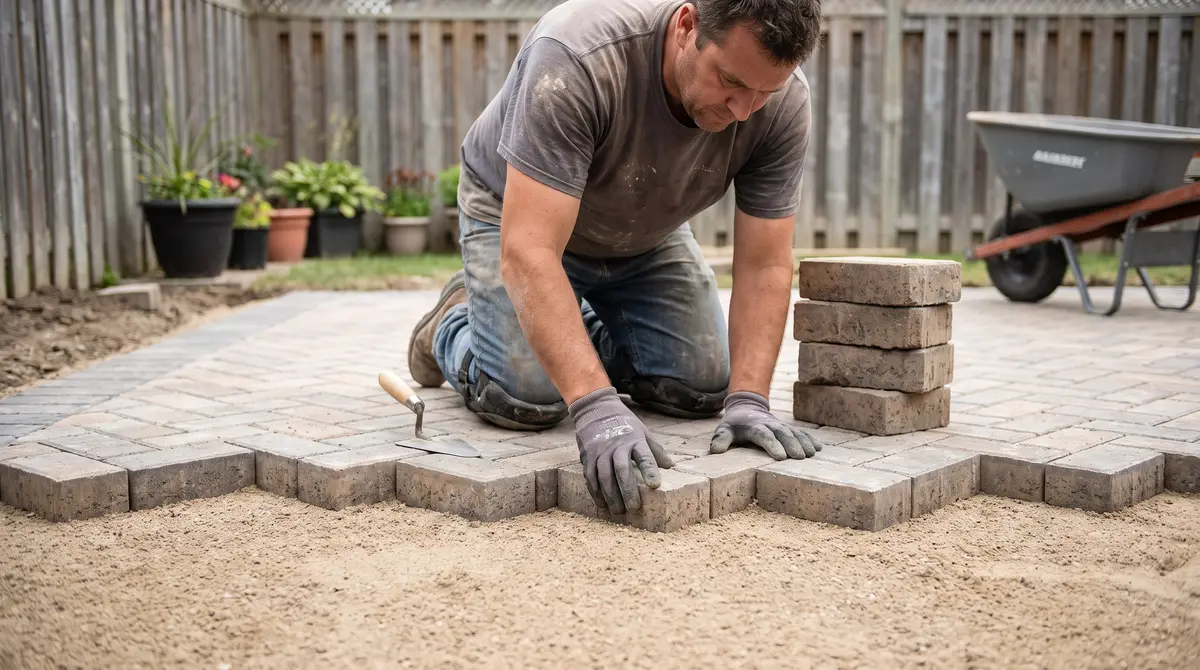
Start by staking and stringing the outline of the patio, walkway or driveway. Add 6 to 12 inches of working room on each side for the edge restraints and base, since the compacted gravel must extend past the pavers to hold them.
Set a fall for water before you dig a single inch. A slope of about 1/4 inch per foot, roughly a 2% pitch, sheds rain away from the house and stops puddles between the joints. Carry that same slope through every layer, base and sand included, not just the paver surface.
Then count your pavers by area. Measure the square footage, add 5 to 10% for cuts and breakage, and note the paver thickness so you can work out how deep to dig. To size the base, sand and paver count in one pass, enter the dimensions in the paver calculator.
How deep to excavate for pavers
Total depth is simple to add up: paver thickness plus 1 inch of bedding sand plus the gravel base. For a foot-traffic patio or walkway that means digging about 7 to 10 inches; for a driveway carrying cars it climbs to 10 to 14 inches because the base gets much thicker.
Dig depth = Paver thickness + 1 in sand + Base depth (4 to 12 in)Soil and climate move those numbers. Heavy clay or a freeze-thaw region wants an extra 2 to 4 inches of gravel to resist frost heave, while firm sandy ground can run at the shallow end.
| Use | Gravel base | Sand | Typical dig depth |
|---|---|---|---|
| Patio / walkway | 4 to 6 in | 1 in | 7 to 9 in |
| Clay or cold climate | 6 to 8 in | 1 in | 9 to 11 in |
| Driveway (cars) | 8 to 12 in | 1 in | 11 to 14 in |
Once the trench is cut, remove all grass and roots and compact the exposed subgrade so nothing settles under the base.
Build and compact the gravel base
The base carries the whole assembly, so use 3/4 inch minus crushed gravel (also called crusher run or 3/4 inch dense grade), never dirt or fine stone dust. Fines trap water and let the pavers sink, rotate and separate within a season.
If the soil is clay or drains poorly, lay a woven geotextile fabric over the subgrade first. It keeps the gravel and soil from mixing and is close to essential under a driveway.
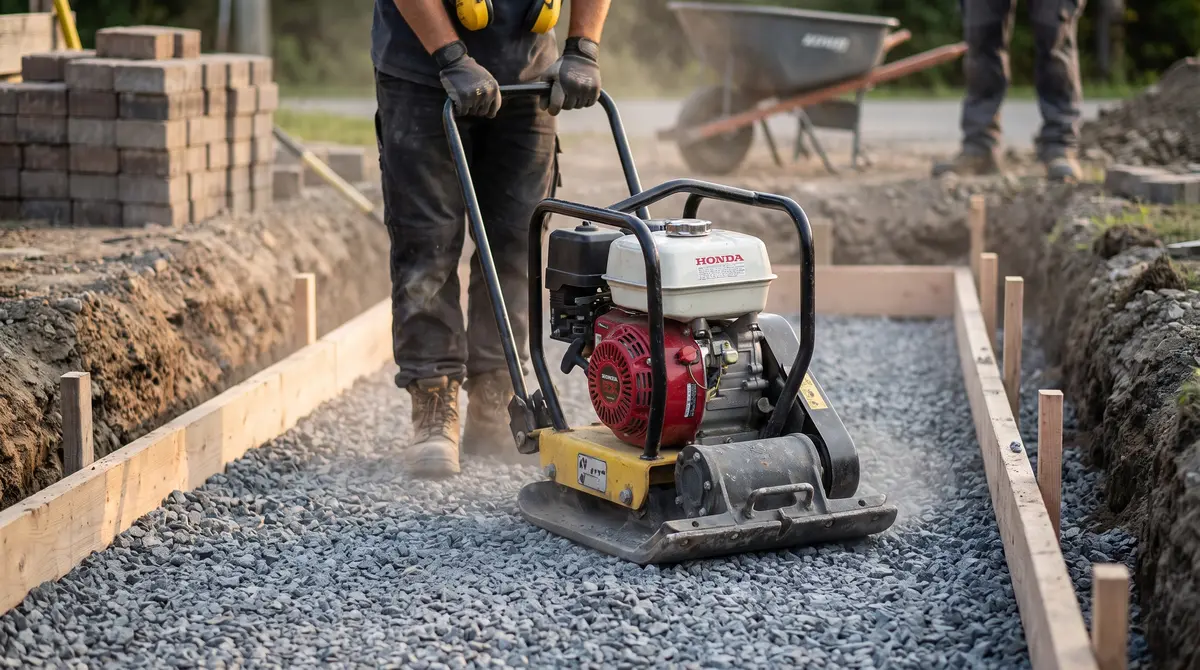
Spread and compact the gravel in 2 to 4 inch lifts, wetting it lightly and running a plate compactor over each layer before adding the next. Compacting the full depth in one go leaves a soft base that fails. The finished surface should be flat to within about 1/8 inch and hold the 2% slope.
Set edge restraints and screed the sand bedding
Install plastic paver edging around any side that is not already held by a rigid structure like a house wall or a concrete curb. Spike it into the compacted base so the pavers cannot creep outward under load.
Now screed a uniform 1 inch of coarse concrete sand over the base. Lay two 1 inch pipes as guide rails, drag a straight board across them to level the sand, then pull the rails and fill the grooves. Do not compact this layer, and do not use fine play sand, which is too soft to hold a paver.
Lay the pavers in your pattern
Start in a 90 degree corner against a fixed edge and work outward, setting each paver straight down onto the sand rather than sliding it, so you do not plow ridges. Run a string line every few feet to keep the courses true, and pull pavers from several pallets at once to blend any color variation.
Keep consistent joints, about 1/8 inch for standard concrete pavers, which the spacer nubs on most units handle for you. Patterns like herringbone lock together best under vehicle loads but need more cut pieces at the borders.
Cut edge pieces with a diamond wet saw, a paver splitter or a hammer and chisel, wearing eye protection. If you would rather not guess how many full and cut pavers a pattern needs, the paver calculator returns the count plus base and sand volumes.
Compact, sand the joints and finish
Lay a rubber pad or old carpet on the plate compactor and run it over the pavers to seat them into the bedding sand, working the edges first and then the field in overlapping passes. The 1 inch sand layer compresses to about 1/2 to 5/8 inch as the pavers settle.
Sweep polymeric sand across the surface and into every joint, filling to about 1/8 inch below the paver top. A 50 lb bag covers roughly 75 to 100 square feet of tight joints, close to one bag per 100 sq ft, and far less on wide or tumbled pavers.
Blow off all excess sand from the paver faces, then mist the joints in light passes to set the polymer, without flooding it. Let it cure 24 hours before walking on the patio, longer before parking on a driveway.
What laying pavers costs
State the selected paver system, measured areas, edge lengths, base depths and delivery in each quote.
Frequently asked questions
What do you put down before laying pavers?
How deep should you dig to lay pavers?
Can I lay pavers directly on sand without gravel?
What kind of sand goes under pavers?
How long after laying pavers can you walk on them?
Sources and references
These references and structured source records support the method and material data used on this page.
- CMHA: Construction of Interlocking Concrete Pavements
- ASTM C936: Standard Specification for Solid Concrete Interlocking Paving Units
- OSU Extension: 10-Step Guide to Installing Pavers (PDF)
- Concrete Masonry & Hardscapes Association (CMHA)