How Many Bags of Mortar Per 100 Block?
You need about 3 bags of masonry cement mixed with sand, or roughly 8 to 10 bags of pre-mixed 80 lb mortar, to lay 100 standard 8 by 8 by 16 inch concrete blocks with 3/8 inch joints and face-shell bedding. The count depends entirely on which product you buy, so below is the math for both, the bag counts by size, costs, and a calculator that does it for you.
Key takeaways
- Pre-mixed mortar: about 8 to 10 bags of 80 lb, or 12 to 14 bags of 60 lb, lay 100 standard blocks.
- Masonry cement method: about 3 bags of cement plus roughly 0.4 cubic yards of sand per 100 blocks.
- One 80 lb bag of pre-mixed mortar lays roughly 10 to 12 blocks at 3/8 inch joints, face-shell bedding.
- Full bedding uses about 60% more mortar than face-shell, so add bags if you butter the whole block.
- The mortar calculator needs a product yield that matches the block, joint and bedding method; its optional cost is limited to the mortar quantity priced.
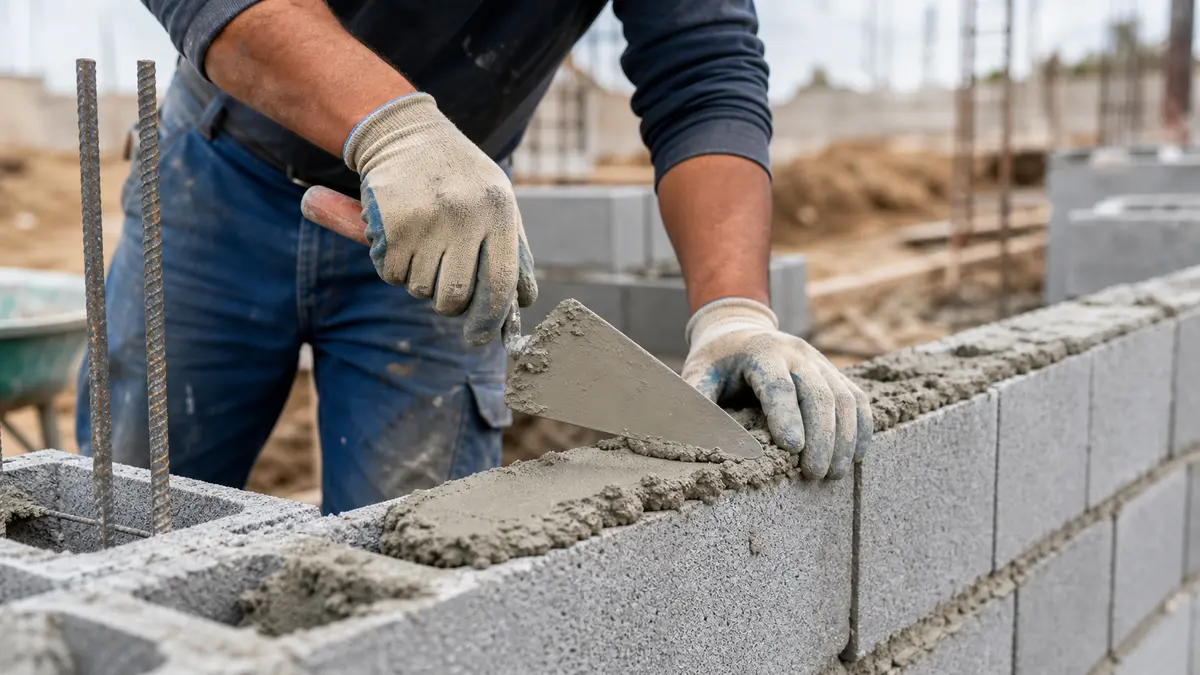
The short answer: bags of mortar per 100 block
The count splits into two products that people both call mortar. Masonry cement is a bag of cement you mix with your own sand, and the trade rule is 3 bags per 100 block. Pre-mixed mortar already has the sand blended in, so each bag does less and you need more of them.
For pre-mixed, plan on about 8 to 10 bags of 80 lb or 12 to 14 bags of 60 lb per 100 standard blocks. These figures assume a standard 3/8 inch joint and face-shell bedding, where mortar sits only on the outer edges of the block.
| Product per 100 block | Bags needed | Notes |
|---|---|---|
| Masonry cement + sand | 3 bags | Add about 0.4 cu yd sand |
| Pre-mixed 80 lb | 8 to 10 | 3/8 in joint, face-shell |
| Pre-mixed 60 lb | 12 to 14 | 3/8 in joint, face-shell |
To skip the conversions, drop your block count and joint size into the mortar calculator and it returns bags by size and the sand needed for the cement method.
Mortar volume per block and the 3/8 inch joint
Everything starts from one number: how much mortar a single block uses. For a standard 8 by 8 by 16 inch CMU with face-shell bedding and a 3/8 inch joint, plan on about 0.057 cubic feet of mortar per block, a figure consistent with National Concrete Masonry Association practice.
So 100 blocks need about 5.7 cubic feet net. Add 10% for waste, droppings and tooling losses and you land near 6.3 cubic feet of mortar for the wall.
Mortar (ft3) = Blocks x 0.057 x 1.10 (waste)The joint size drives this. The masonry standard is a 3/8 inch joint, and going thicker quietly burns through extra bags. If you are estimating block counts first, the concrete block calculator gives the wall area in blocks before you size the mortar.
Pre-mixed mortar: how many 80 lb and 60 lb bags
Pre-mixed bags are the simplest route for a small to mid wall, since you just add water. The catch is yield: an 80 lb bag of pre-mixed mortar makes roughly 0.67 cubic feet, and a 60 lb bag about 0.45 cubic feet.
Divide the 6.3 cubic feet for 100 blocks by those yields and you get about 10 bags of 80 lb or 14 bags of 60 lb. Manufacturer rules of thumb run a touch leaner, often quoting 10 to 12 blocks per 80 lb bag, which is where the 8 to 10 bag figure comes from.
| Bag size | Yield per bag | Blocks per bag | Bags per 100 block |
|---|---|---|---|
| 80 lb | 0.67 ft3 | 10 to 12 | 8 to 10 |
| 60 lb | 0.45 ft3 | 7 to 8 | 12 to 14 |
| 40 lb | 0.30 ft3 | 5 | 20 |
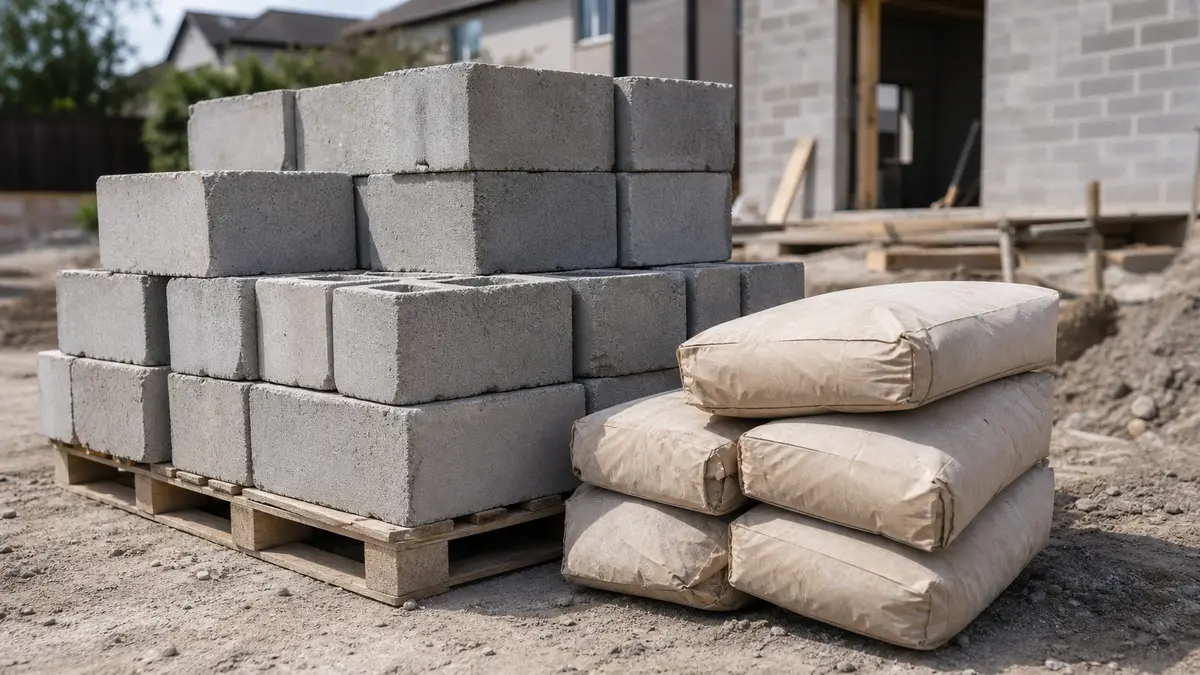
Masonry cement method: 3 bags plus sand
Compare options only after defining the specified mortar type, product yield and measured block quantity.
That works out to roughly 0.4 cubic yards of mortar sand per 100 blocks. A common mix is 1 bag of 70 lb Type N masonry cement to about 18 to 20 shovels of masonry sand and 4 to 5 gallons of clean water.
Type N suits most above-grade walls; Type S is the higher-strength choice for foundations, retaining walls and anything below grade. If you are also filling cores or a bond beam, the concrete calculator handles the grout and fill volume separately from the mortar in the joints.
Face-shell vs full bedding and what it costs
Bedding type changes the count more than people expect. Face-shell bedding, mortar on the outer shells only, is standard for most load-bearing CMU walls and is what the 8 to 10 bag figure assumes. Full bedding, where you butter the entire block face, uses roughly 60% more mortar.
So 100 blocks with full bedding can climb to about 22 bags of 60 lb, used on the first course, on solid units, or where codes call for it. Confirm what your design requires before you buy.
Frequently asked questions
How many bags of mortar do I need for 100 concrete blocks?
How many blocks will one 80 lb bag of mortar lay?
What is the rule of thumb for mortar per 100 block?
How much sand do I need to mix mortar for 100 blocks?
Should I use Type N or Type S mortar for block?
Sources and references
These references and structured source records support the method and material data used on this page.
- Mortar (Wikipedia)
- QUIKRETE Mortar Mix No. 1102 (data sheet)
- NCMA: National Concrete Masonry Association
- ASTM C270: Standard Specification for Mortar for Unit Masonry