How Many Bricks to Build a House?
A house brick takeoff must start with exterior wall area, openings, brick module and number of wythes; floor area alone is not enough. The worked example below states one 45 by 45 foot, single-storey veneer assumption and shows the arithmetic. Use actual elevations and the selected brick data for a project quantity, then apply a current supplier quote.
Key takeaways
- Standard modular brick runs about 7 per square foot of wall with a 3/8 inch mortar joint; use 6 to 6.5 for a true standard brick.
- A single-wythe brick veneer on a 2,000 sq ft home needs roughly 10,000 to 12,000 bricks; a double-wythe structural wall doubles that.
- Count wall area, not floor area: multiply the outside perimeter by wall height, subtract doors and windows, then multiply by 7.
- Always add 5 to 10% for waste, cuts and breakage, and round up to full pallets of 500.
- Apply the selected supplier's current unit or pallet price only after checking the elevation-based quantity and packaging.
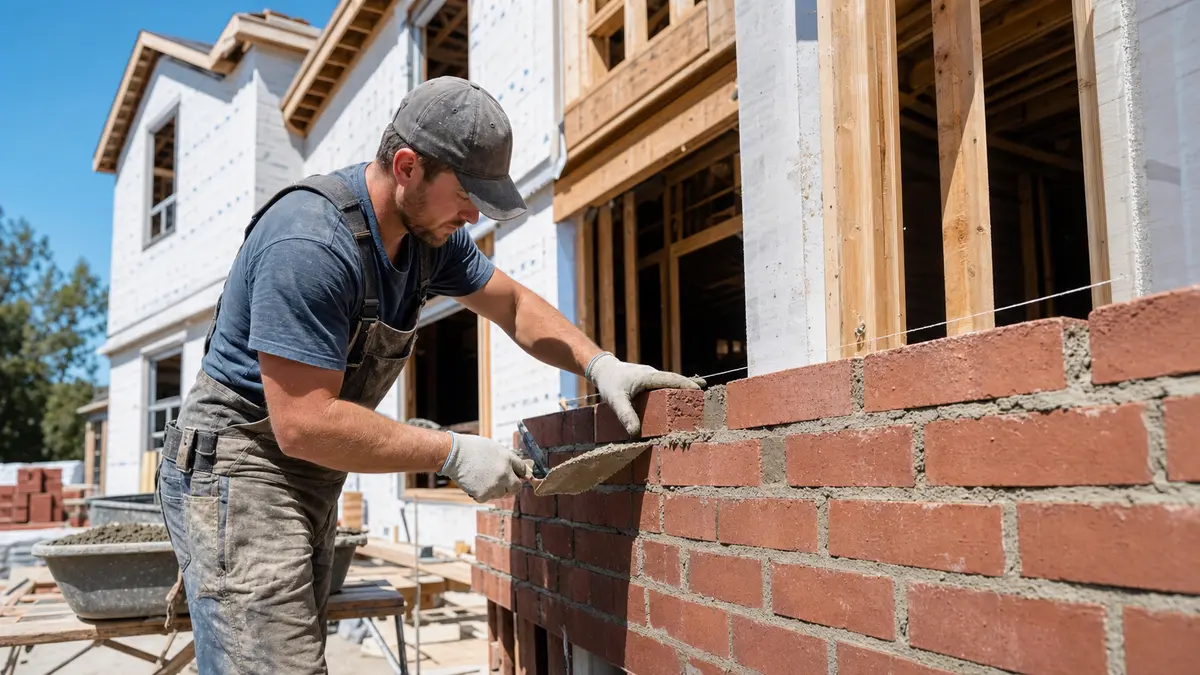
The formula: bricks per square foot of wall
Brick is estimated by wall area, not floor area. Find the total wall area in square feet, subtract the openings for doors and windows, then multiply by the number of bricks each square foot takes. For standard modular brick that figure is about 7 bricks per square foot.
That 7 already includes the standard 3/8 inch mortar joint, which is why the count is based on the nominal brick face of 8 inches by 2 2/3 inches, not the smaller physical brick.
Wall area (ft2) = Perimeter(ft) x Height(ft) - OpeningsBricks = Wall area x 7 x 1.10 (waste)Add 5 to 10% for waste, cuts and breakage, because you cannot dye-match a second order perfectly. To skip the arithmetic, enter your wall dimensions in the brick calculator and it returns bricks, mortar bags and cost.
How many bricks per square foot by brick size
The 7 per square foot rule assumes a standard modular brick. Larger bricks cover more wall, so they lower the count. Below are the common US sizes with a 3/8 inch joint.
| Brick type | Nominal face | Bricks per sq ft |
|---|---|---|
| Modular | 8 x 2 2/3 in | 6.75 to 7 |
| Standard | 8 x 2 1/4 in | 6 to 6.5 |
| Queen | 8 x 2 3/4 in | 6.5 |
| Engineer | 8 x 3 1/5 in | 6 |
| Norman | 12 x 2 2/3 in | 4.5 |
Mortar joint width matters too. A tighter 1/4 inch joint adds about 8% more bricks per square foot, while a 1/2 inch joint takes off about 7%. Confirm your exact brick before ordering, since a single-skin veneer and a double-wythe structural wall differ by a factor of two.
Worked example: bricks for a 2,000 sq ft house
Take a single-story 2,000 square foot home measuring roughly 45 by 45 feet, which is a perimeter of about 180 feet. With 9 foot walls that is 1,620 square feet of gross wall area.
Subtract about 300 square feet for doors and windows and you have 1,320 square feet of brick. At 7 bricks per square foot that is 9,240 bricks, or about 10,200 with 10% waste. Add a second story and the count climbs toward 18,000 to 20,000.
If your house is not a simple rectangle, break each wall run into rectangles, find the area of each, add them, then subtract the openings once at the end.
How much mortar and how many pallets you need
Premixed mortar must not be confused with masonry cement used in a site-mixed mortar. QUIKRETE Mortar Mix No. 1102 lists up to 37 standard bricks per 80 lb bag, so 1,000 bricks require at least 28 bags before a project-specific waste allowance. At that maximum yield, 10,000 bricks require at least 271 bags before rounding and allowance.
Pallet counts and minimum orders vary by manufacturer and supplier, so round to the actual packaging after confirming the product. For a mortar estimate by wall size, see how much mortar you need.
Use the mortar type specified for the assembly and exposure; product selection is separate from the coverage calculation.
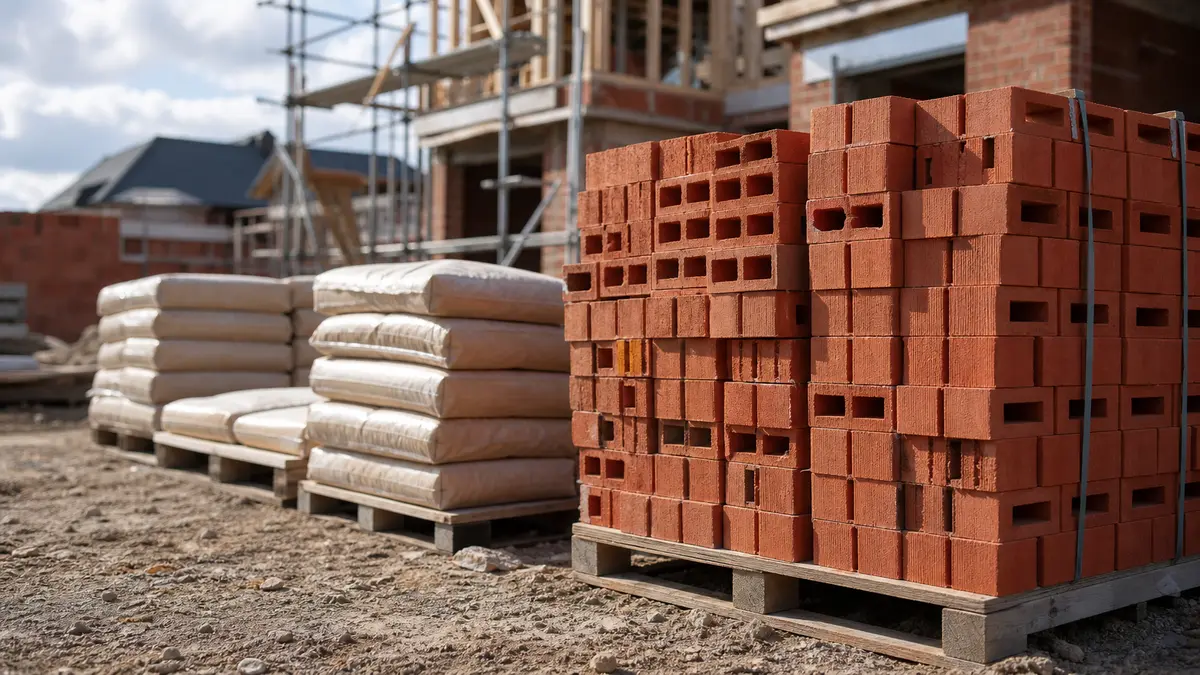
Apply current brick and installation quotes
Ask the selected brick supplier for unit or pallet price, pallet quantity, minimum order, delivery, returns and batch availability. Multiply the checked purchase quantity by that current quote.
For installed work, issue the same elevations, wall system, openings, details, access and finish scope to each bidder. Keep brick, mortar, accessories, scaffolding and labor visible rather than relying on an unsupported national rate.
The worked house quantity on this page is illustrative. Replace its footprint, wall height, openings and brick module with project evidence.
Tips to order the right amount and avoid running short
The most common mistake is estimating from floor area instead of wall area. A 2,000 square foot house does not need 2,000 square feet of brick, it needs however much wall you wrap, which is usually less on one floor and more across two.
The second is forgetting the waste and the openings. Subtract the doors and windows, then add 5 to 10% back for cuts and breakage, and order the difference as full pallets so a dye lot mismatch does not force a visible patch later.
If you are also bricking a garden wall, pier or chimney, price those separately, since the brick house guide on block quantities is a better fit for a structural backup wall. For the whole-house number with mortar and cost worked out, plug your measurements into the calculator rather than estimating by hand.
Frequently asked questions
How many bricks do I need to build a 2,000 sq ft house?
How many bricks are in a square foot?
How much does it cost in bricks to build a house?
How do I calculate how many bricks I need?
How many bricks are on a pallet?
Sources and references
These references and structured source records support the method and material data used on this page.
- Brick (Wikipedia)
- Brick Industry Association Technical Note 10
- ASTM C216: Facing Brick Specification
- QUIKRETE Mortar Mix No. 1102 data sheet