Concrete Driveway Cost Worksheet
Budget a concrete driveway from its measured area and approved slab section, then add demolition, drainage, base, reinforcement, concrete, finish and site access. The dollar tables demonstrate arithmetic with replaceable assumptions; they are not current market-price data.
Key takeaways
- Measure the driveway footprint and use the approved thickness to calculate concrete volume.
- Traffic, soil support, drainage and joints affect the required slab and base details.
- Decorative finishes add distinct materials, placement, curing, sealing and maintenance scope.
- Compare quotes with demolition, base, reinforcement, concrete, access and finish all stated.
- The price ranges are illustrative inputs, not verified market averages.
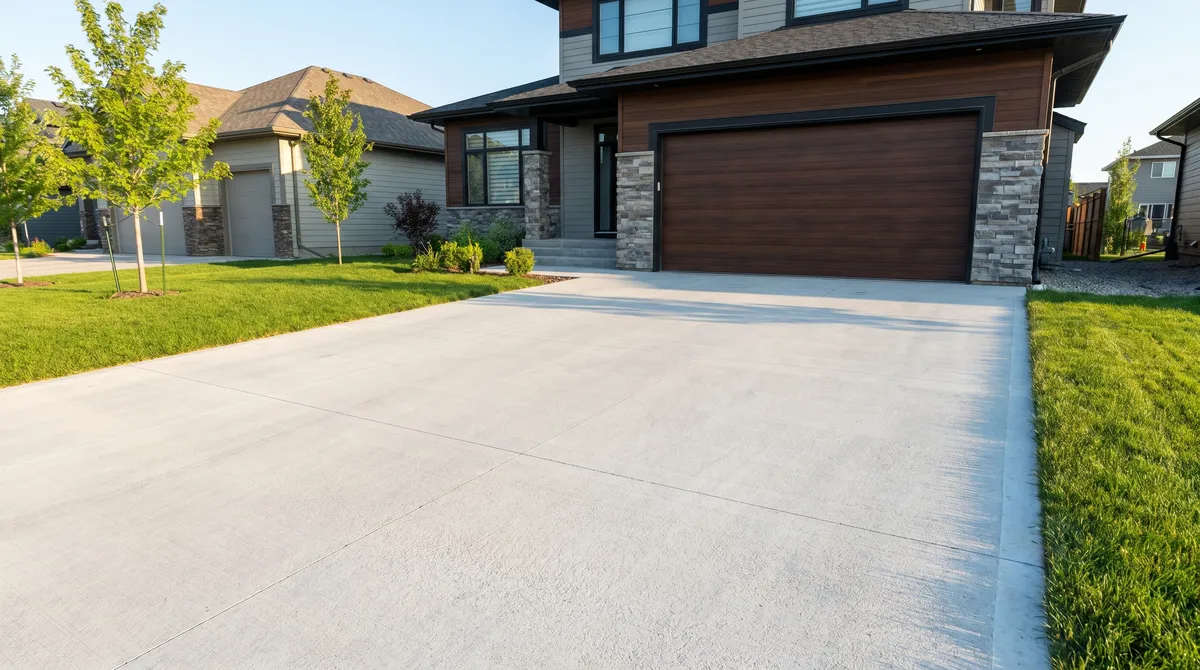
Illustrative concrete driveway cost per square foot worksheet
| Finish | Assumed input per sq ft |
|---|---|
| Plain gray, broom finish | 6 to 12 dollars |
| Integral color added | +1 to 2 dollars |
| Exposed aggregate | +2 to 4 dollars |
| Stamped concrete | 10 to 18 dollars+ |
Per square foot pricing is only the start. To turn it into a real number for your driveway, you need the area and the thickness, which is where a concrete slab calculator earns its keep by converting your dimensions into cubic yards, bags, and an estimated cost.
Concrete driveway cost by size: single-car to three-car
| Driveway size | Area | Illustrative input (plain gray) |
|---|---|---|
| Single-car (10x24 ft) | 240 sq ft | 1,600 to 4,000 dollars |
| Two-car (20x20 ft) | 400 sq ft | 2,400 to 4,800 dollars |
| Two-car (16x40 ft) | 640 sq ft | 3,800 to 7,700 dollars |
| Three-car (24x36 ft) | 864 sq ft | 5,200 to 13,500 dollars |
If your driveway is not a clean rectangle, break it into rectangles, find each area, and add them up before you multiply by the rate.
How thickness and rebar change the price
Stamped and decorative concrete driveway cost
Decorative finish changes materials, placing and curing requirements. Request a separate local option that states color, pattern, release agent, sealer, sample approval and maintenance scope.
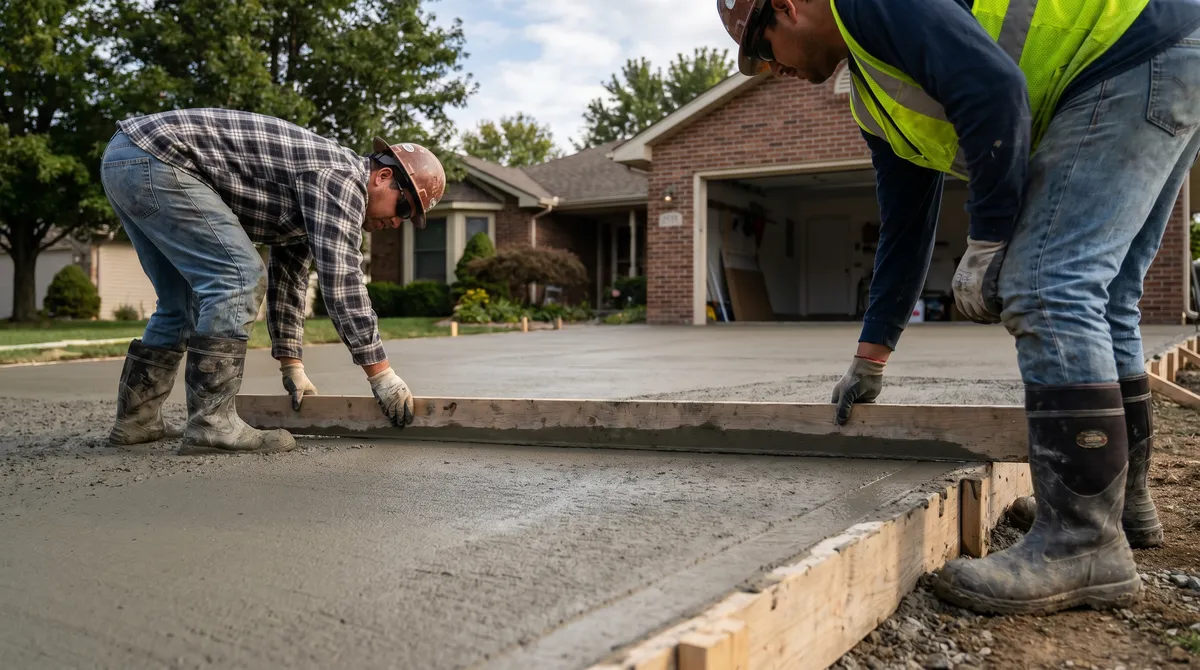
Comparing concrete and asphalt driveway quotes
State the driveway area, slab section, drainage, reinforcement, finish and site work in each quote. State base, drainage, thickness, reinforcement, finish, maintenance and study period for each system before comparing totals.
Site conditions and extras that raise the total cost
State the driveway area, slab section, drainage, reinforcement, finish and site work in each quote.
Use the concrete slab calculator to check cubic yards and bag counts from approved dimensions, then apply current quoted rates. Quantity arithmetic alone cannot establish whether a bid is fair.
Frequently asked questions
How much would a 100 ft concrete driveway cost?
How much does it cost to pour a 20x20 driveway?
How should I compare concrete and asphalt driveway quotes?
How should I compare driveway material options?
How thick should a concrete driveway be?
Sources and references
These references and structured source records support the method and material data used on this page.
- Concrete (Wikipedia)
- NRMCA: Ready Mixed Concrete
- American Concrete Institute (institutional site)
- Portland Cement Association