How Many Retaining Wall Blocks Do I Need?
To find how many retaining wall blocks you need, divide the wall length in inches by the block length, then multiply by the number of rows (wall height divided by block height), and add 5 to 10% for cuts and breakage. A 20 foot long, 3 foot high wall built with standard 16 inch blocks needs about 90 blocks plus waste. Below is the formula, worked examples by wall size, how block dimensions change the count, and a calculator that does it for you.
Key takeaways
- Blocks per row = wall length in inches divided by block length; rows = wall height divided by block height.
- A 20 x 3 ft wall with 16 in long, 6 in high blocks needs 15 per row x 6 rows = 90 blocks, plus 5 to 10% waste.
- Standard segmental blocks run about 12 in wide and 4 to 8 in high; smaller faces mean more blocks per square foot.
- Add one cap block for every block in the top row, and bury the entire first course below grade.
- The retaining-wall calculator counts field units, caps and entered base material after the system dimensions are known; it does not select wall design, drainage or reinforcement.
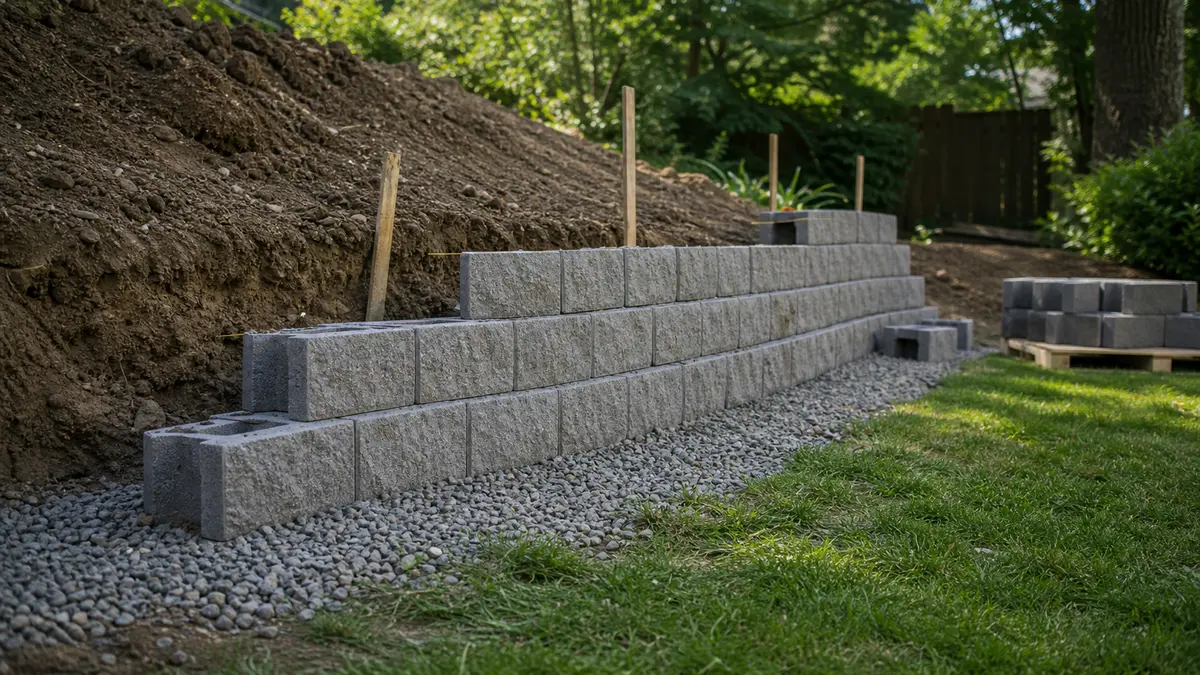
The formula to calculate retaining wall blocks
Retaining wall blocks are counted by the wall face, not by volume. You need two numbers: how many blocks fit in one row, and how many rows tall the wall is.
Blocks per row is the wall length divided by the block length, using the same units. Rows is the wall height divided by the block height. Multiply the two and you have the block count for the wall body.
Blocks per row = Wall length(in) ÷ Block length(in)Rows = Wall height(in) ÷ Block height(in)Total blocks = Blocks per row x Rows x 1.10The 1.10 is a 5 to 10% waste factor for cut end blocks, corners, and breakage, which you cannot skip on a wall with any curves. To get the count plus caps and base material with no math, enter your numbers in the retaining wall calculator.
How many blocks per square foot of wall
Because block faces vary, there is no single blocks per square foot figure. The face area of one block is its length times its height in inches, divided by 144. A common 12 inch wide by 4 inch high block face is 0.33 square feet, so it takes about 3 blocks per square foot of wall.
A taller block face covers more, so you buy fewer pieces. A 16 inch by 6 inch face is 0.67 square feet, or roughly 1.5 blocks per square foot, while a 16 inch by 8 inch face drops it to about 1.1 per square foot.
| Block face (L x H) | Face area | Blocks per sq ft |
|---|---|---|
| 12 x 4 in | 0.33 sq ft | 3.0 |
| 16 x 6 in | 0.67 sq ft | 1.5 |
| 16 x 8 in | 0.89 sq ft | 1.1 |
| 18 x 6 in | 0.75 sq ft | 1.3 |
Note that block sizes shift by region and brand. In Canada and Europe you will often see soft metric units, so confirm the exact length and height printed on the pallet before you divide.
Worked examples by wall length and height
The fastest way to sanity check a quote is to run a couple of real walls. These use a typical 16 inch long block and assume a 6 inch high unit, with 10% waste already added and rounded up.
| Wall size | Blocks per row | Rows | Total (+10%) |
|---|---|---|---|
| 10 x 2 ft | 8 | 4 | 36 |
| 20 x 3 ft | 15 | 6 | 99 |
| 30 x 3 ft | 23 | 6 | 152 |
| 40 x 4 ft | 30 | 8 | 264 |
A 20 foot by 3 foot wall is 240 inches long, so 15 blocks fit per row, and 36 inches of height at 6 inches per block is 6 rows, giving 90 blocks before waste and about 99 after. For curved walls or walls that step up a slope, the cuts add up fast, so plan closer to the 10% end.
Don't forget caps, the buried base course, and gravel
The block body is only part of the order. You also need one cap block for every block in the top row, set in masonry adhesive, which finishes the wall and sheds water.
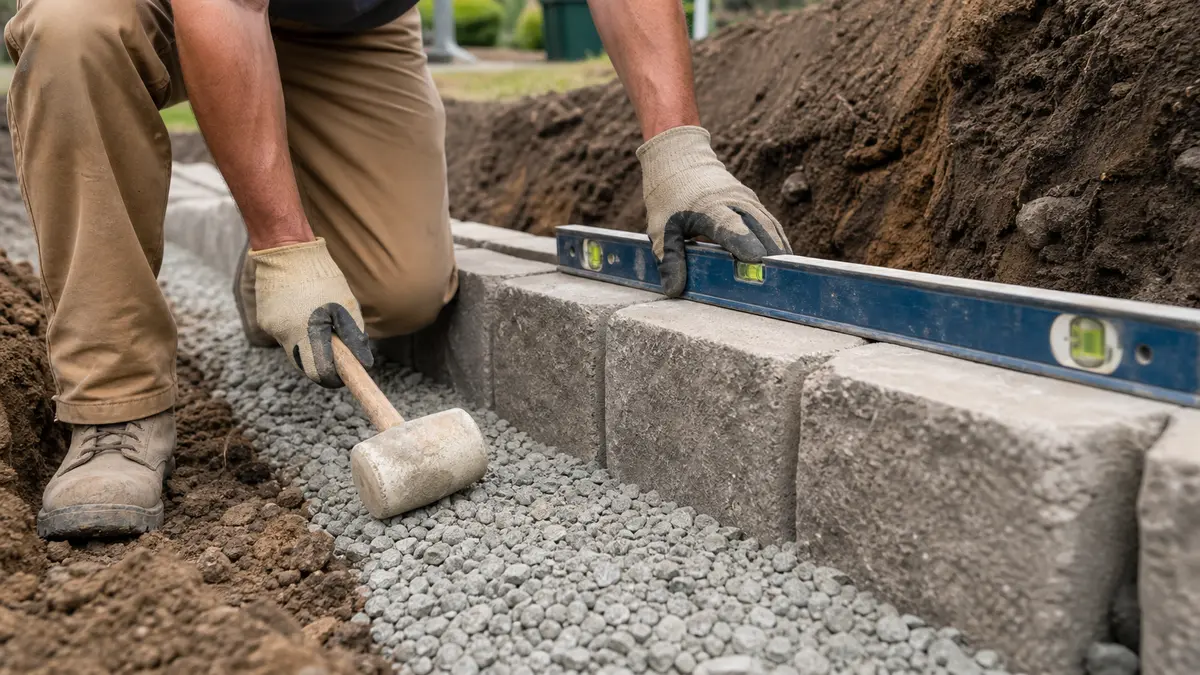
You also bury the entire first course below grade. A solid rule of thumb is to bury about 1 inch of block per foot of exposed height, or one full course minimum, set on 6 inches of compacted angular crushed stone, not pea gravel. Those buried blocks count toward your total, so include them in the height.
For the gravel base and backfill behind the wall, a separate volume calculator helps you size the crushed stone in cubic yards once you know the trench dimensions.
What retaining wall blocks cost
If you are weighing the full picture, the companion guides on retaining wall cost break down installed pricing and where the money goes beyond the blocks themselves.
When you need a permit or an engineer
Block count is a materials question, but wall height is a safety question. Under the International Building Code, Section 105.2, earth retaining structures over 4 feet tall require a building permit, and usually an engineered design.
Unreinforced gravity block walls are generally limited to about 3 to 4 feet. Above that, or where the wall holds back a slope, a driveway, or any surcharge load, you need geogrid reinforcement and a professional engineer, per the NCMA Design Manual for Segmental Retaining Walls.
Even a short wall can need a permit if it carries a surcharge, so confirm with your local building department before you order. For the per area math behind a budget, see the breakdown of retaining wall cost per square foot.
Frequently asked questions
How many retaining wall blocks do I need for a 20 foot wall?
How do I calculate how many blocks for a retaining wall?
How many retaining wall blocks are in a square foot?
How tall can a retaining wall be without engineering?
Do I need cap blocks for a retaining wall?
Sources and references
These references and structured source records support the method and material data used on this page.
- Retaining wall (Wikipedia)
- NCMA / CMHA: Segmental Retaining Walls
- CMHA (institutional site)
- ICC (institutional site)